
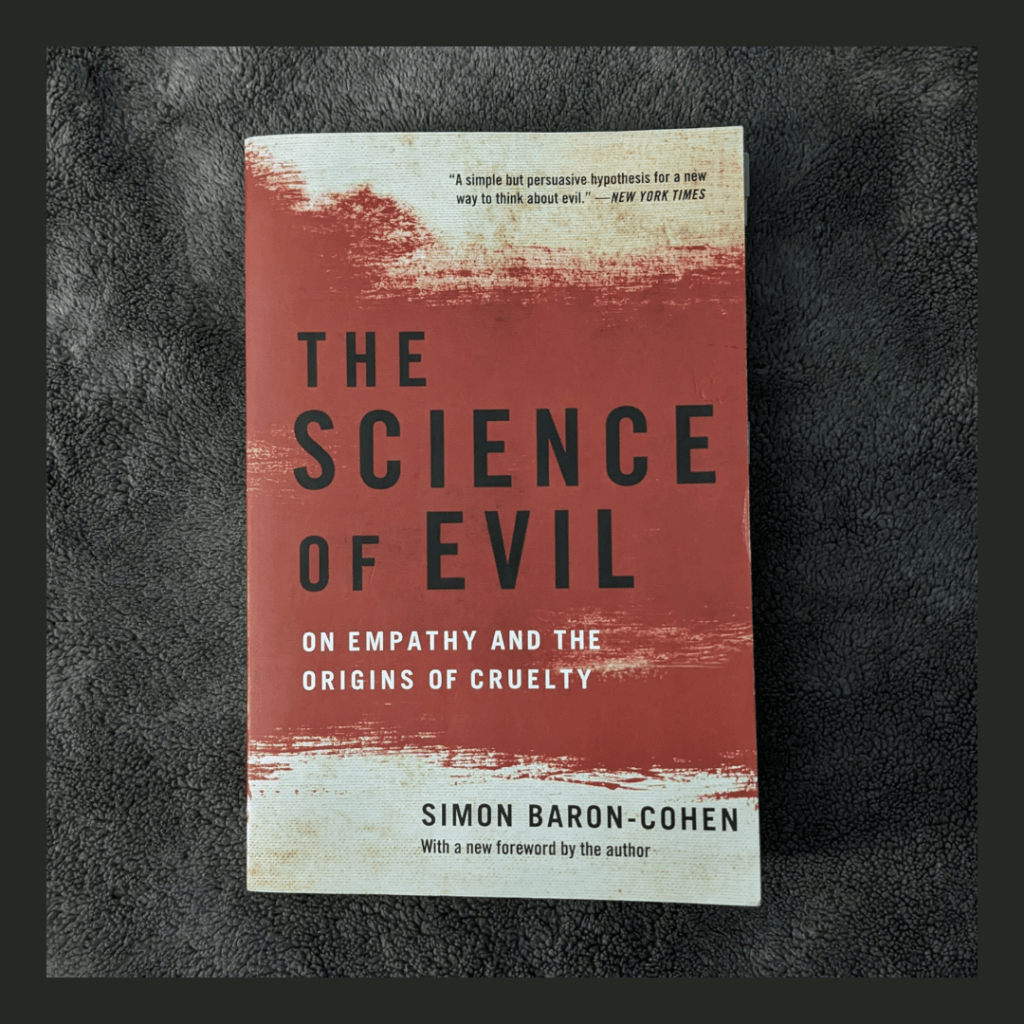
If you think the author’s name is familiar, you would be correct, he is the cousin of comedic actor Sacha Baron-Cohen. That’s probably one of the more interesting tidbits I got from reading this book. After enjoying Range by David Epstein so immensely last week, I was left incredibly disappointed in how little I enjoyed The Science of Evil. I didn’t even try very hard to take a decent picture, I just wanted to be done with this one. So I apologize for the lackluster picture and the slightly scathing review you are about to read.
I don’t want to crap on it entirely, there were some pieces of information I found interesting. I found the concept of thinking of evil as an erosion of empathy a thought-provoking topic. I even enjoyed the discussion of how this erosion can begin. I even had a little bit of fun as I took The Adult Version of the Empathy Quotient (EQ), which can be found on page twenty three, of which I will not be sharing my score. I pondered most over what Level I thought I fell into within the Empathizing Mechanism. Basically, I was fascinated with the science of the first two chapters in this text, but from there it started to fall off for me.
The next chapter, which made for good reading from a scientific standpoint, dragged a little. The author went into the three personality types in which persons with the least empathy would fall into, Borderline, Psychopath, and Narcissist. There are twenty pages going over real life human examples of Borderline types, why these people are like this, what are the causes, what their brains are like, and so forth. There are then another twenty plus pages which go over the Psychopath personality type. But then there are only seven short pages discussing the Narcissist personality type, and I felt robbed. The following chapter discussed the positive side of lacking empathy, in the way of autism and Aspergers. I have nothing positive or negative to say regarding this section, it was just an alright chapter for me. Following this, there is a chapter that goes into the genetic implications of having low, medium, or high levels of empathy, which was fairly interesting. Then it got weird.
You would think that this book would stick to what is based in fact, or theories that can be hypothesized based on research, the science of what causes a person to have low, medium, or high empathy. The title of the book itself leads you to believe this is a purely scientific text. But the last chapter, which I found difficult to enjoy and even more challenging to see how it fit in with the rest of the book, got religious. I just didn’t feel like the last chapter had a place in this particular book. I think the book would have been better having left it out entirely.
Since I can’t think of a better way to end this blog post, let me just say that I am hoping for a more enjoyable book next week.
 Nonfiction and Nonsense