
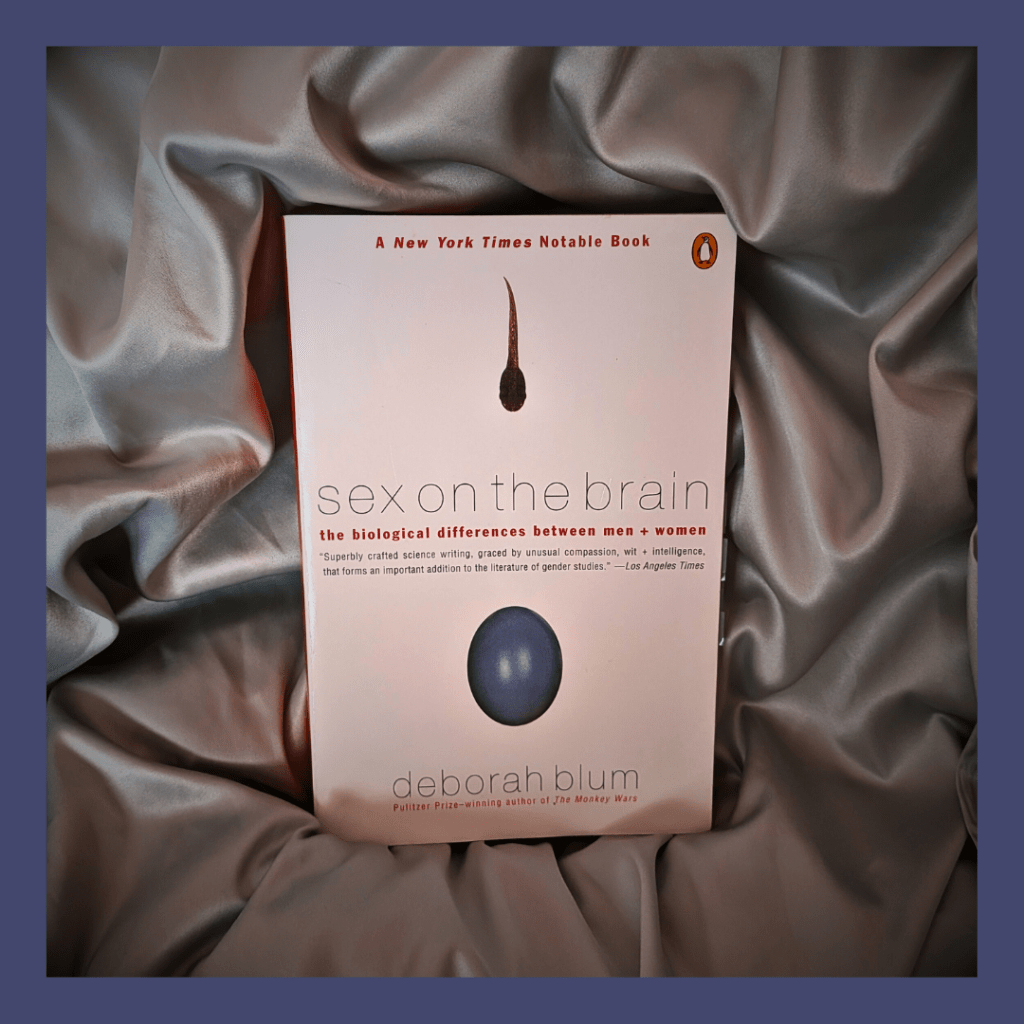
Even though this book was first published in 1997, I found that a lot of the information inside was still relevant and held nearly thirty years later when I decided to read it. I have found that you can tell a book was well researched, and that the theories the author chose to discuss were founded on solid science, when the science is still being studied in the present and the theories are still being pursued. And that was certainly the case here.
This book touches on many different topics that relate to the biological differences between men and women. There are reasons why we are wired the way that we are. Some traits we have carried with us are no longer necessary, think about the useless appendix, and other traits have always been and may always be required for us to function. The author discusses such topics as why is morning sickness still a thing, gossip, the mystery of monogamy, the evolutionary theory as to why it is advantageous for all species to have homosexuality, and the reason why some hetersexual men get both angry and jealous of homosexual male couples. Really, this book has it all. There are two particular topics that I wanted to discuss with some depth as they are topics that I am always drawn to. And I chose these in particular because the author was discussing them back in 1997, and they are still important bits of science that those in the field are still considering today.
The author seemed to have really good intuition into what the future holds genetically in a passage discussing chromosomes. The X chromosome has most of the genetic code on it, around two thousand genes, whereas the Y chromosome has less than eighty. It is widely known that it is the male’s genetic material which determines the gender of the child, women’s eggs are all X chromosomes and male sperm have either an X or Y chromosome. The Y chromosome mostly just exists as a signal to make the embryo into a male human. Without the Y chromosome, we would all be female. Scientists are currently trying to determine if a female’s bone marrow could be used to fertilize an egg, thus creating a human with the genetic contribution of two women rather than a woman and a man. If this is something that can be done, males will eventually become obsolete. Being a man does put you at a disadvantage genetically, and if in the future more people are more concerned as a society about producing a healthy child, then they might not want the option of having a male. If you are a woman and you inherit a bad gene on one X chromosome, but a healthy version of the same gene on the other X chromosome, you get the good one. The same is not always true for a man, if that gene does not exist on the Y chromosome then you get stuck with the bad gene. There are many disorders that are more prevalent in men for this reason. I found this extremely fascinating.
Another topic that always captures my interest is body size in relation to male genital size. In species where the males are physically much larger than the females, you will see very small genitals. When the females and males are similar in body size, the genital size becomes more proportionate to that of the body. The topic was touched only briefly, but it was explained in easy to understand terms here. But I always find the theoretical discussions on this topic insightful from an evolutionary standpoint. I enjoy pondering the why behind the designs of animal forms.
Besides the very entertaining biological content, I was really amused with the names of some of the people in this text. I found it hilariously coincidental that several people had names that suited their careers. John Wingfield, an avian biologist, and Marc Breedlove, a behavioral endocrinologist who studies hormones, just to name two. And as I have said a few times before, a non fiction book, regardless of the topic, is always much more pleasant to read when it is well written. The author had a sense of humor and was relatable. I like it when an author adds tidbits from their life that go hand in hand with what they are writing about.
 Nonfiction and Nonsense