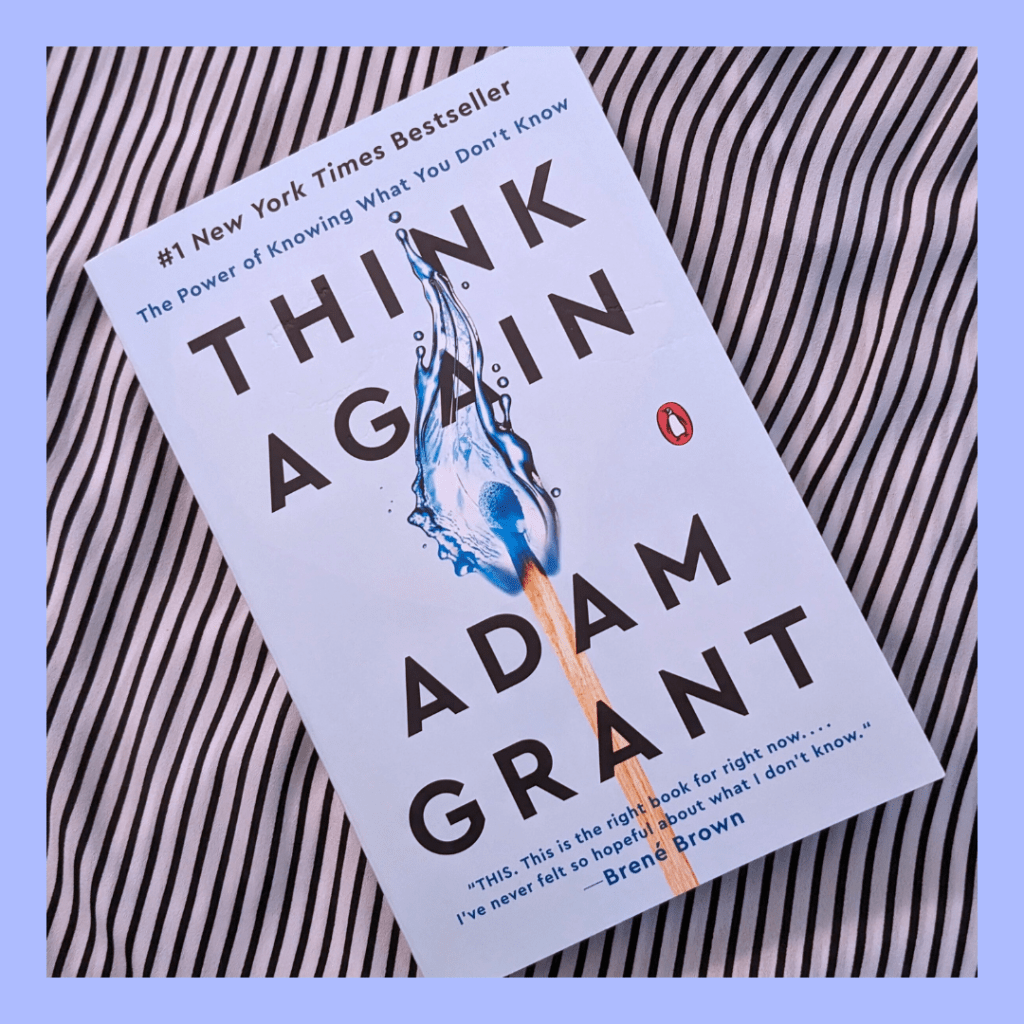
Think Again by Adam Grant

I wonder if it is a huge coincidence that within the first few pages of this book, the author mentioned an incident that was also discussed in the book I read two weeks ago, that being Range by David Epstein. I remembered the story of firefighters dying as they tried to outrun a forest fire, because they didn’t consider that the equipment they were carrying could be dropped. The equipment was a part of them, they had been trained to treat their tools as an extension of themselves. Only when it dawned upon one man that they stood a better chance of reaching safety if they dropped everything in order to gain speed were some of them able to escape the flames. The story was told there as an example of why we need to look beyond using the tools we are familiar with, which is a very abbreviated summary of the entire chapter, one which I very much enjoyed. In Think Again, the author used the survival strategy of one man as his opening argument for why it is beneficial to think of alternatives when what you know, what usually works, isn’t working. The firefighters that are trained to battle the most destructive forest fires use tools to try to stop them, heavy tools like chainsaws and axes. If the team comes to the realization that they cannot stop the fire, they resort to retreating. But there are some occasions in which the fire is moving at such a speed that even making the decision to give up on the task may be too little too late. In this such incident even after dropping their equipment it didn’t look as though the firefighters would be able to outrun the flames. So one man, Wagner Dodge, did something that seemed insane. He started another fire. 

If you are considering reading this book, or if you want to look up the Mann Gulch fire of 1949, I won’t tell you why Wagner Dodge decided to create an additional smaller fire in the midst of a giant forest fire. It is actually pretty clever, and it makes for a spectacular introduction to this book. So if you couldn’t tell by my very large first paragraph, I did very much enjoy reading this. The author has a sense of humor, which I have said before and will say again, makes non fiction so much more pleasurable to read. There are charts, graphs, comics, and other visuals that provide you with nice examples to go along with the concepts you are reading through. I think the key ideas that I took away from this text are to be humble, be ok with making fun of yourself when you are wrong, always ask questions, don’t be afraid to break tradition or rattle the cage, and if you want something done, find the grumpiest people you can and tell them the task at hand is impossible because stubborn people love to prove others wrong. 

May is halfway over and that means I am halfway through all the books I had picked out for the month. I had two great reads and one disappointing one, so I am optimistic about the remaining two I have waiting for me. Wish me luck, it’s been a while since I have read this many non fiction books in a row, I usually take a break in between every one or two with a science fiction or romance novel. I hope to see you back next week where I will have another review hopefully praising another amazing book.
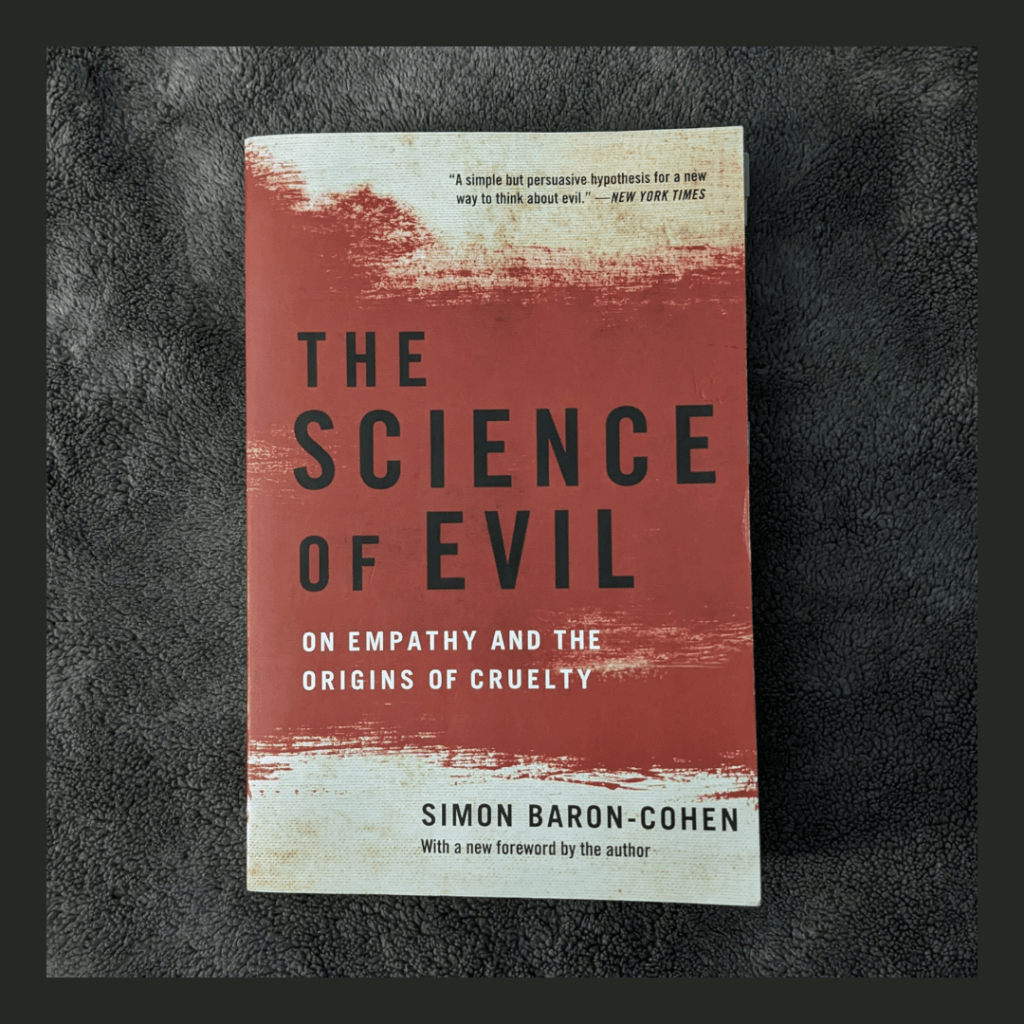
The Science of Evil by Simon Baron-Cohen

If you think the author’s name is familiar, you would be correct, he is the cousin of comedic actor Sacha Baron-Cohen. That’s probably one of the more interesting tidbits I got from reading this book. After enjoying Range by David Epstein so immensely last week, I was left incredibly disappointed in how little I enjoyed The Science of Evil. I didn’t even try very hard to take a decent picture, I just wanted to be done with this one. So I apologize for the lackluster picture and the slightly scathing review you are about to read.

I don’t want to crap on it entirely, there were some pieces of information I found interesting. I found the concept of thinking of evil as an erosion of empathy a thought-provoking topic. I even enjoyed the discussion of how this erosion can begin. I even had a little bit of fun as I took The Adult Version of the Empathy Quotient (EQ), which can be found on page twenty three, of which I will not be sharing my score. I pondered most over what Level I thought I fell into within the Empathizing Mechanism. Basically, I was fascinated with the science of the first two chapters in this text, but from there it started to fall off for me.

The next chapter, which made for good reading from a scientific standpoint, dragged a little. The author went into the three personality types in which persons with the least empathy would fall into, Borderline, Psychopath, and Narcissist. There are twenty pages going over real life human examples of Borderline types, why these people are like this, what are the causes, what their brains are like, and so forth. There are then another twenty plus pages which go over the Psychopath personality type. But then there are only seven short pages discussing the Narcissist personality type, and I felt robbed. The following chapter discussed the positive side of lacking empathy, in the way of autism and Aspergers. I have nothing positive or negative to say regarding this section, it was just an alright chapter for me. Following this, there is a chapter that goes into the genetic implications of having low, medium, or high levels of empathy, which was fairly interesting. Then it got weird.

You would think that this book would stick to what is based in fact, or theories that can be hypothesized based on research, the science of what causes a person to have low, medium, or high empathy. The title of the book itself leads you to believe this is a purely scientific text. But the last chapter, which I found difficult to enjoy and even more challenging to see how it fit in with the rest of the book, got religious. I just didn’t feel like the last chapter had a place in this particular book. I think the book would have been better having left it out entirely.

Since I can’t think of a better way to end this blog post, let me just say that I am hoping for a more enjoyable book next week.

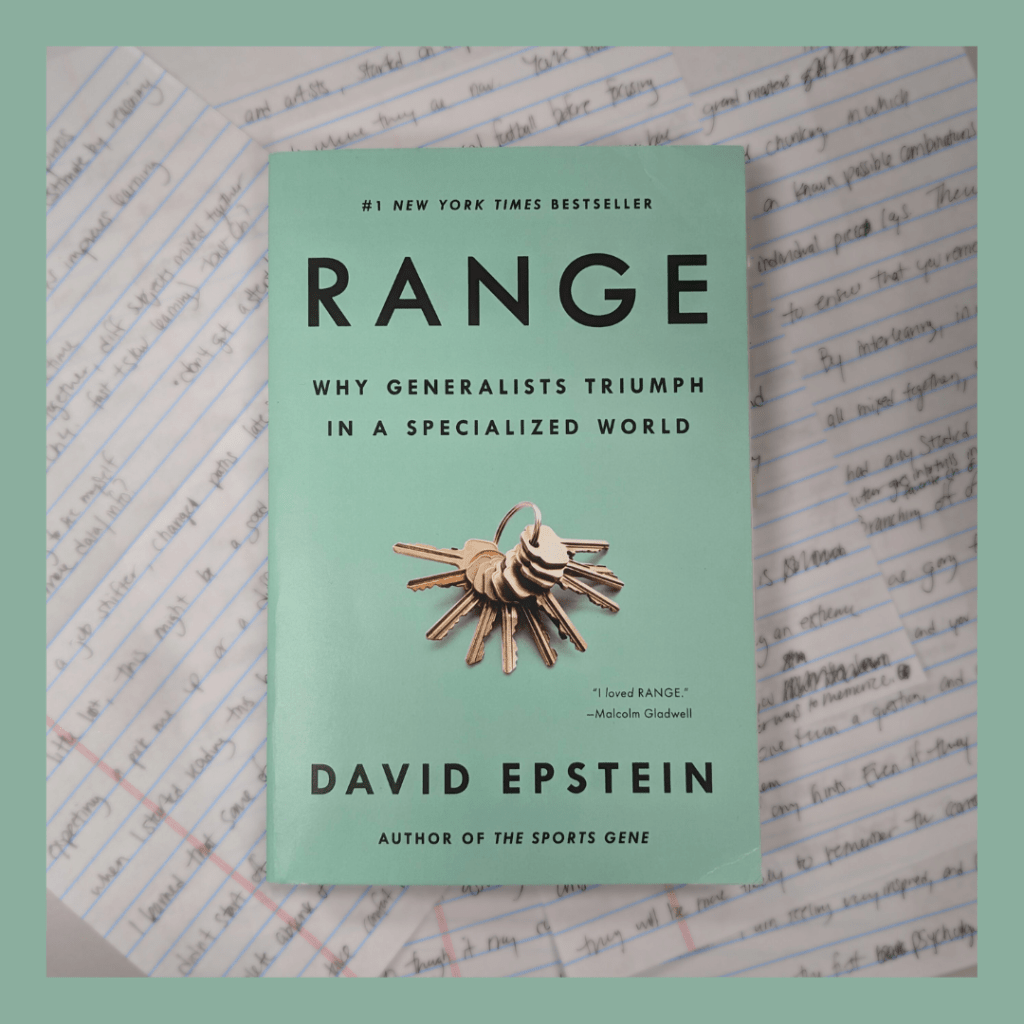
Range: Why Generalists Triumph In A Specialized World by David Epstein

If you are a job shifter, changed paths later in life, or maybe you just feel a little lost, this might be a good book for you to read. I wasn’t expecting a pick me up from this book, or a different way of looking at my life, when I started reading. But that is exactly what happened. I learned that some of the best professionals in their particular fields didn’t start off there, that sometimes their planned path, or their complete absence of a plan, began in a completely different place. You can take comfort in the fact that not all the greatest athletes, doctors, actors, scientists, and artists, started along the path that you would have expected them to in order to have led them to where they are now. Your favorite basketball player may have run the gamut of soccer, baseball, and football before focusing on shooting hoops in college. A Nobel prize winning biologist may have gone to university with the intention to be a lawyer. A world famous CEO may have had no college education at all, they may have been content in their life as a parent and member of the community, but through chance and the observations of others they were encouraged to enter the business world. The author goes through many examples of these sorts of people. As far as intriguing tales, chapter nine had some of my favorites. 

This book is so much more than explaining why it is better to have a vast array of knowledge in many areas rather than having a very large amount of knowledge regarding a single subject. It also teaches you better memorization techniques. Chess grand masters in part gain that elite status by a memorization method called chunking, in which they group together several pieces on the board based on known possible combinations rather than trying to remember where each individual piece lies. There are also methods on better ways to learn to ensure that you remember information long term instead of short term. By interleaving, in which you study different topics at the same time all mixed together, you are more likely to hold onto the information if you had studied any one topic intensely before moving on to the next one. The author goes into detail about this in chapter four, another favorite chapter of mine. Branching off of that, a good research strategy is to think about how you are going to conduct that research before you even start it. Are you a teacher and you want your students to be better learners? Hit them with a question and try to get them to answer it without giving them any hints. Even if they come up with the wrong answer they will be more likely to remember the correct one, and accept that their answer was incorrect on top of it, than if you had helped them. 

I don’t know if it was the author’s intention, but by the end of the book I felt better about my varied education that always seems to confuse others when I tell them about my studies. I also started to feel a little bit better regarding my professional career path that I started later than I believe I should have. I still need to work on feeling like I am not behind. According to this book, my best years are probably soon approaching, my professional peak or my true calling may be just within my reach. Exploring different options, and taking chances, and being curious is a good thing. After reading this book I now want to be more adventurous and intuitive. I want to try to do as Fermi did and try to guess or estimate problems and questions by reasoning. I want to be confident and comfortable when I consider asking if there is more information rather than assuming I’ve been handed everything I need in order to make a decision. Even though it may ruffle feathers, sometimes going against protocol is the only way to prevent potential disasters. I am left feeling very inspired, and I hope this feeling stays with me. To think, this is only the first psychology book I have lined up to read for this month’s planned agenda. I hope the rest of the books in my pile give me just as much to consider.

Update: So Much Psychology

I didn’t have a theme last month, unless you want to count reading through my to be read pile as a theme. But in May, I do have one. I am a huge lover of psychology and psychiatry, I kind of consider learning about the human mind and human behaviors a hobby. At one point in my life I was going to school to become a clinical mental health counselor, but I decided that it wasn’t for me. Even though I decided that I wasn’t up for helping people with their mental health in a professional sense, I didn’t give up my love for the subject along with those short wished aspirations of mine. I always have a few books on the subject piled in my room, waiting to be read. After organizing all my books by subject I found that I had quite a few psychology books, enough to make it a theme for a whole month. So if non fiction isn’t really your thing, you might not enjoy my blog for the next month or so, there are going to be a lot of educational reviews posted very soon. However, if you choose to stick around, and I hope that you do, I will say that in June I have a lot of Sci-fi and fantasy books planned. In fact, the entire summer is going to be full of witches, monsters, muses, fairy tales, warriors, all very exciting fantasy things.

A Brief History Of The Female Body by Deena Emera

I read this book in tandem with the last book I posted about, and if I were a sex education teacher or a professor of human sexuality I would include both of these books on my mandatory reading list. I would put this book at the very top of that imaginary list, as I found it very easy to read and well written, especially for a text that educates so well. I am always appreciative of a text that is educational but also entertaining. Are You Coming? was more of what I would call fun educational, A Brief History Of The Female Body was more evolutionary and theoretical educational. I read so many fascinating things that I was happy to feed my brain.  I feel a little bad for my friends, I was so enthusiastic about certain theories that I started talking at length about them. I think I may have bored them a bit with my nerding out. 

So I guess that is a good way to segue into what I found so amazing about this book. Are you interested in reading about some of the theories that try to determine why human females are the only mammals that have breasts year round, not just during pregnancy and breastfeeding? This is the case with all other mammals, what makes us so different? Or, do you want to learn about why we are one of the few species that menstruates, and so frequently at that? These are just a few of the topics that I found myself mesmerized by. The other topics covered in this book include pregnancy, and everything that goes with it, child rearing, diseases, menopause, and love and bonding. The beginning is a little heavy on chromosomes, genetics, and evolution. It can be reminiscent of high school science class but it was much more enjoyable than classroom learning. There are also some nice illustrations that I found very helpful, as trying to visualize what the author was describing was not easy at times. 

I love that professionals in the field are getting even more involved in studying the female body. From what I have been reading, for a long time scientists thought that they knew all they needed to know. But there are still many, many mysteries when it comes to the female reproductive system and other bodily functions and body parts that are particular to the female. I look forward to hearing more about it from both this author and others.