Range: Why Generalists Triumph In A Specialized World by David Epstein

If you are a job shifter, changed paths later in life, or maybe you just feel a little lost, this might be a good book for you to read. I wasn’t expecting a pick me up from this book, or a different way of looking at my life, when I started reading. But that is exactly what happened. I learned that some of the best professionals in their particular fields didn’t start off there, that sometimes their planned path, or their complete absence of a plan, began in a completely different place. You can take comfort in the fact that not all the greatest athletes, doctors, actors, scientists, and artists, started along the path that you would have expected them to in order to have led them to where they are now. Your favorite basketball player may have run the gamut of soccer, baseball, and football before focusing on shooting hoops in college. A Nobel prize winning biologist may have gone to university with the intention to be a lawyer. A world famous CEO may have had no college education at all, they may have been content in their life as a parent and member of the community, but through chance and the observations of others they were encouraged to enter the business world. The author goes through many examples of these sorts of people. As far as intriguing tales, chapter nine had some of my favorites. 

This book is so much more than explaining why it is better to have a vast array of knowledge in many areas rather than having a very large amount of knowledge regarding a single subject. It also teaches you better memorization techniques. Chess grand masters in part gain that elite status by a memorization method called chunking, in which they group together several pieces on the board based on known possible combinations rather than trying to remember where each individual piece lies. There are also methods on better ways to learn to ensure that you remember information long term instead of short term. By interleaving, in which you study different topics at the same time all mixed together, you are more likely to hold onto the information if you had studied any one topic intensely before moving on to the next one. The author goes into detail about this in chapter four, another favorite chapter of mine. Branching off of that, a good research strategy is to think about how you are going to conduct that research before you even start it. Are you a teacher and you want your students to be better learners? Hit them with a question and try to get them to answer it without giving them any hints. Even if they come up with the wrong answer they will be more likely to remember the correct one, and accept that their answer was incorrect on top of it, than if you had helped them. 

I don’t know if it was the author’s intention, but by the end of the book I felt better about my varied education that always seems to confuse others when I tell them about my studies. I also started to feel a little bit better regarding my professional career path that I started later than I believe I should have. I still need to work on feeling like I am not behind. According to this book, my best years are probably soon approaching, my professional peak or my true calling may be just within my reach. Exploring different options, and taking chances, and being curious is a good thing. After reading this book I now want to be more adventurous and intuitive. I want to try to do as Fermi did and try to guess or estimate problems and questions by reasoning. I want to be confident and comfortable when I consider asking if there is more information rather than assuming I’ve been handed everything I need in order to make a decision. Even though it may ruffle feathers, sometimes going against protocol is the only way to prevent potential disasters. I am left feeling very inspired, and I hope this feeling stays with me. To think, this is only the first psychology book I have lined up to read for this month’s planned agenda. I hope the rest of the books in my pile give me just as much to consider.
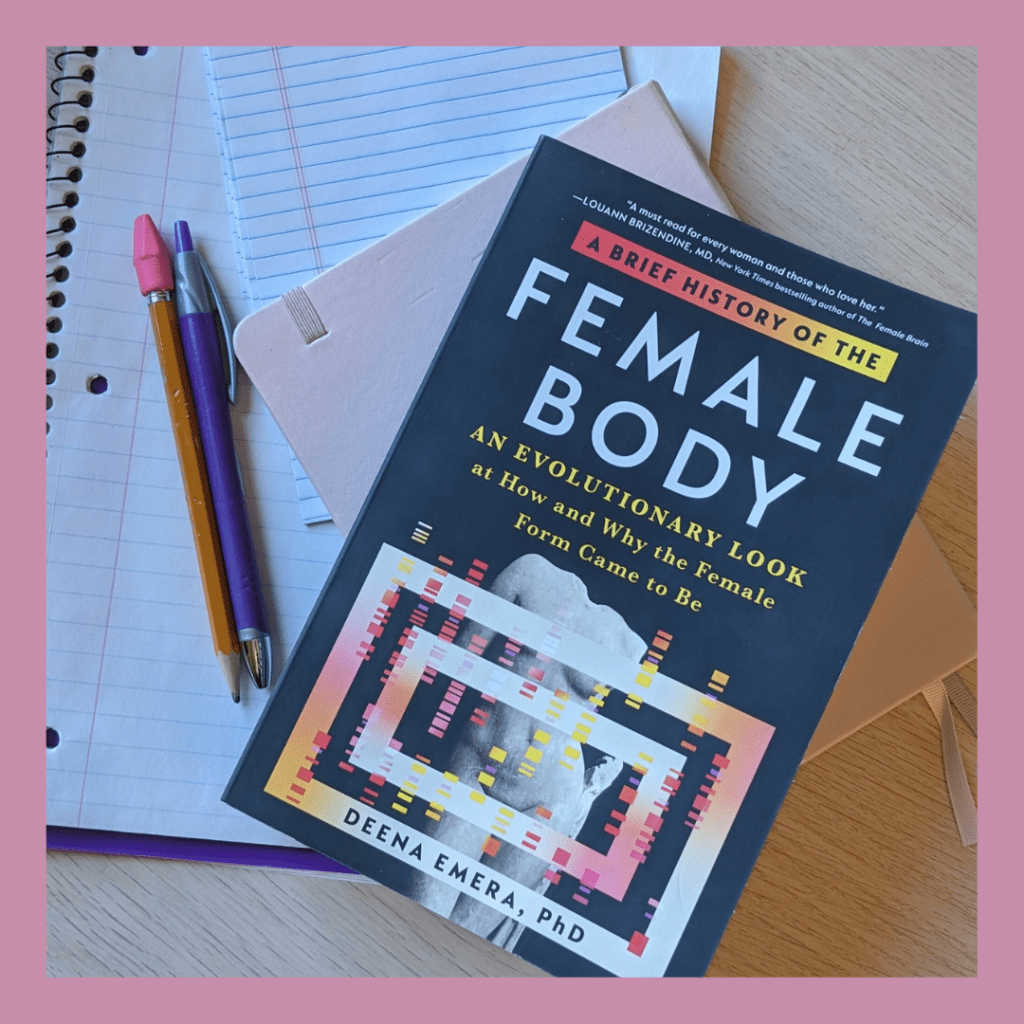
A Brief History Of The Female Body by Deena Emera

I read this book in tandem with the last book I posted about, and if I were a sex education teacher or a professor of human sexuality I would include both of these books on my mandatory reading list. I would put this book at the very top of that imaginary list, as I found it very easy to read and well written, especially for a text that educates so well. I am always appreciative of a text that is educational but also entertaining. Are You Coming? was more of what I would call fun educational, A Brief History Of The Female Body was more evolutionary and theoretical educational. I read so many fascinating things that I was happy to feed my brain.  I feel a little bad for my friends, I was so enthusiastic about certain theories that I started talking at length about them. I think I may have bored them a bit with my nerding out. 

So I guess that is a good way to segue into what I found so amazing about this book. Are you interested in reading about some of the theories that try to determine why human females are the only mammals that have breasts year round, not just during pregnancy and breastfeeding? This is the case with all other mammals, what makes us so different? Or, do you want to learn about why we are one of the few species that menstruates, and so frequently at that? These are just a few of the topics that I found myself mesmerized by. The other topics covered in this book include pregnancy, and everything that goes with it, child rearing, diseases, menopause, and love and bonding. The beginning is a little heavy on chromosomes, genetics, and evolution. It can be reminiscent of high school science class but it was much more enjoyable than classroom learning. There are also some nice illustrations that I found very helpful, as trying to visualize what the author was describing was not easy at times. 

I love that professionals in the field are getting even more involved in studying the female body. From what I have been reading, for a long time scientists thought that they knew all they needed to know. But there are still many, many mysteries when it comes to the female reproductive system and other bodily functions and body parts that are particular to the female. I look forward to hearing more about it from both this author and others. 

Are You Coming? by Laura Hiddinga

If you have the anatomy of a female, this book is a must read. Most Americans have some form of sex education in school, and I’d like to think my elementary, middle, and high school lessons on the subject were very good, especially when compared to the curriculum of the nation at large. But I learned things from this book that I did not learn in school. To be fair, I will say that a great deal of the information includes discoveries that were probably made well after I graduated high school. Even so, it’s amazing to me that there are so many more different forms of female pleasure than I was previously aware of. On top of that, science is still waiting to discover even more about the female body. 

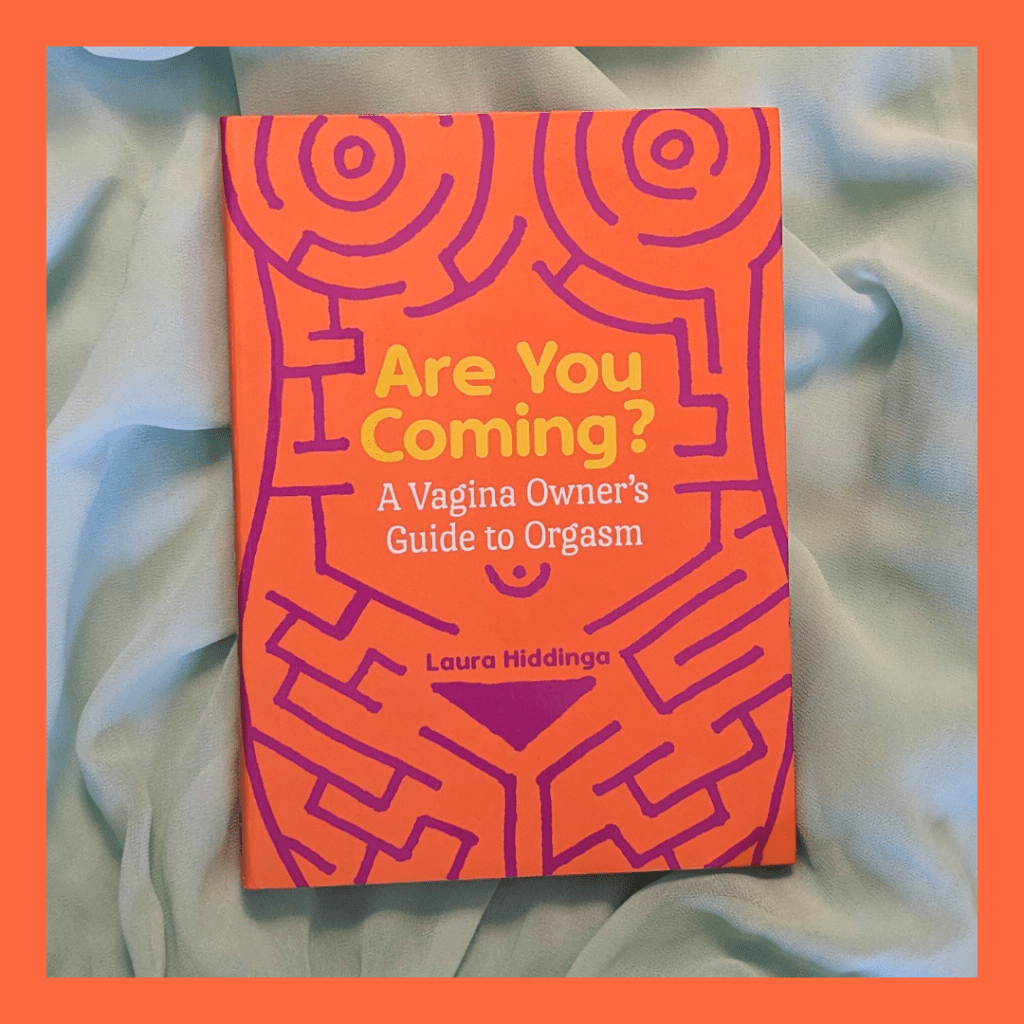
If you don’t want to read an entire book on the subject, even just reading one of the chapters could be very enlightening. In these pages you might find the answers to some problems you might be having, or you might learn that something that you personally experience has a name and is experienced by others as well, making you feel less alone or even amongst friends in a way. The book is broken down into the basics, the different types, techniques, how to talk about it, difficulties with it, positions, and devices you can add. For the length of this book, your money is worth what you pay for it. I also love the cover art. The female body being portrayed as a maze that you need the patience and time to navigate is what I believe the author was going for here, in terms of an artistic metaphor. I explore the female body even further with the book I will be discussing next week. I was actually reading the two in tandem and just finished this one first, but they compliment each other very well. I hope you’ll return to see what I have to say about it.

How To Justify Torture by Alex Adams

An entire book completely dedicated to the ethics of the ticking time bomb scenario, which I am certain most people have heard a version of at some point in their adult lives. Basically, does saving the many justify the torture of one individual? The author gives several different versions of the hypothetical situation, and with each example, each slight change of the scenario, he constantly asks us whether torture is right or wrong. He is quick to point out that in reality a situation like this could never actually happen, there are too many variables in the hypothetical question that just don’t make sense. The question itself is one to get people thinking, a topic that has been hotly debated since the terrorist attacks of the early 2000s. 

I recommend this book for anyone who enjoys thought invoking questions and listening to both sides of an argument. It’s also great for anyone who loves movies, literature, and television shows that depict torture, as the author uses several examples from the above mentioned media platforms as he discusses the ethics. I found myself not only intrigued with points I had never thought of before, but also interested in a few books that the author used as examples, and I was reminded of an old show that I was fond of many years ago. Although the author is against torture, he does discuss the reasonings and justifications given by those who agree with it. I am always welcoming of a storyteller that discusses both sides of an argument. And while the book did not make me change my mind on what I think about torture, I did see the reasoning behind the side that I am in opposition of.

The Habsburgs: To Rule The World by Martyn Rady

I bought this book a few weeks ago. Coincidentally, while going through the pictures on my phone I saw that I had taken a photo of it many months ago with the intention to buy it at some point because it looked interesting. I guess I decided on purchasing it on this most recent trip because somewhere in the back of my mind I remembered that I was intrigued a long time ago. 

History books can be a little boring for me at times, especially if they are written in a manner that reminds me of high school textbooks. I was never fond of history in school, which is the opposite of how I feel about reading the subject now. I love European history, being that it is laughable when you read about all the terribly planned arranged marriages between men and women who do not suit each other, scandalous when you consider the sheer number of unions made between first cousins, and occasionally between uncles and their nieces, and despicable regarding the things that monarchs and persons in other positions of power would do when they held a grudge. It’s dramatic, and I love it. This book detailed the entire history of the Habsburg family, from the very first of them to come into power to the end of the dynasty in the early 1900s. My favorite chapter, or one of the ones I enjoyed the most, was chapter seventeen which detailed some of Maria Theresa’s rule as empress. Overall, the book is incredibly informative going into who ruled, the accumulation and loss of territory over the centuries, and the politics, art, science, religion, and other important particulars of the times. I also found an amazing woman online who does a series of five videos on the history of the Holy Roman Empire, if you would rather watch a video over reading a book. I will put a link to the first video in her series at the bottom of the post. Her channel name is History Tea Time with Lindsay Holiday and she has a ton of videos. She has a really clear, pleasant voice, and this series has great visualizations with maps, territory lines, portraits, and depictions of art.

There is one detail that made me really enamored of this book. It may seem like a silly little thing but it was a big deal for me. A lot of history books will include a section of pictures, which are usually located somewhere in the middle of the text. A lot of those pictures are placed right in the middle of a chapter, which I have always found annoying as it interrupts the reading. They also are usually placed mid-sentence, which means you either have to go back and restart the sentence after you look at all the pictures or you have to find the end of the pictures and finish reading the sentence before viewing. I very much appreciated that the pictures in this book were placed right at the end of a chapter.