The 7 Habits of Highly Effective People by Stephen R. Covey

This is not a one time read, this is a book you keep on your shelf in plain sight because until you grasp all the concepts, and are practicing them regularly, you both will and should continue to go back to it. It is not the most engaging read, I had to tell myself I wasn’t done for the day unless I finished a chapter. But, it is full of advice and lessons that you can use daily. You won’t become an expert after one read, that is made plain and clear, these habits take time and effort to master. 

I did take a lot of notes while I was reading and I used a lot of post its to mark sections that intrigued me or spoke to me. I do not see myself practicing all of the habits in this book, I do not aspire to become a master of the seven habits, but I do see myself using bits and pieces as a means of self help. I loved that there were a lot of charts, diagrams, and visual examples throughout, they definitely made understanding the concepts much easier. I also loved the many stories the author referred to. It was very fitting, using his real life experiences as a way to teach us about the seven habits. I feel like without these true stories the book would not have been as effective or made as much of an impact as it would have without them. I greatly appreciated the author telling his personal stories. 

I’m not going to explain any of the habits to you, you can only truly learn them and how they can help you if you take the time to read about them for yourself. It would be impossible for me to summarize the contents of this book to anyone, it is vastly informative. But, I can say that I can see this book being good for a lot of people. If you are having problems at work, with family or friends, with your life partner or children, or if you are feeling lost, unmotivated, unsure of what to do, there are solutions for how to deal with all of these issues.

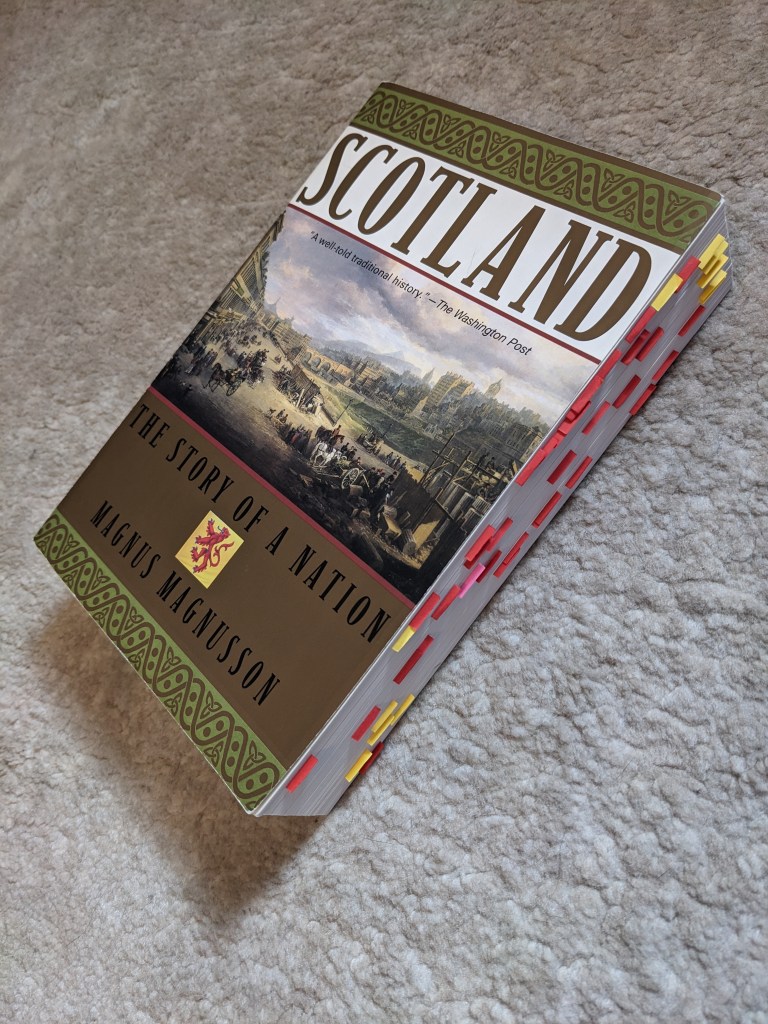
Scotland: The Story of a Nation by Magnus Magnusson

I absolutely loved this book! I have not read a historical account this amazing ever. This almost seven hundred page novel chronicles the entire history of Scotland, from its very beginnings up until the late nineties. It took me forever to read, being almost seven hundred pages, and the text inside being relatively small, but I found myself constantly ready to pick it up and read as much as I could in the time I had set aside for reading. There was not a single moment in which I said to myself, I need to put this down for a while and read something else, because the writing was just so engaging. Shortly after I began reading I knew I needed to find out more about this author and see what other books he had written, because I knew if he had penned other novels about the history of other countries that I would want to read those as well.

Magnus Magnusson, incredible name by the way, was born in Iceland, but made his way over to Edinburgh with his family as a child. Although he is no longer with us, he left behind an incredible collection of novels, including additional works about Scotland, books about Iceland, and books about Vikings. I cannot tell you how excited I am at the prospect of buying all of his works. Even after reading about the entire history of Scotland in this novel, I am hungry to learn more, not just from Mr Magnusson, but from anyone, anywhere. I left so many notes behind in this book, marking pieces of information that intrigued me and subjects that I wanted to learn more about in the future. I have been spoiled here however, as I don’t know if I will ever find another author who writes in such a way that makes history so interesting and enjoyable. I highly encourage anyone to read this book.

The Mastery of Self by Don Miguel Ruiz Jr.

This book I borrowed from my friend after I saw it in his room. I wanted to read it as soon as I saw it because it was laying in the room of a man who does not read, so it must have been something very special for him to have brought it home. 

This is a quick read, but you get so much out of it in the short amount of time it takes to get through it. It’s both religious and spiritual, insightful and helpful, particularly for those who take the time to consider the hypothetical scenarios and perform the exercises at the end of each chapter. It’s also philosophical, you question the methods as you are reading about them, you wonder if the practices as described by the author would actually help you. I found myself interested in trying some of the exercises but also doubting the usefulness of others for me personally. Perhaps I doubted some of the practices because I am in a very negative mood right now, there is not a lot in my life that is going well at the moment. There were a lot of ideas that I did not see as being useful for me in the present or in the future. Perhaps I should come back to this book when I am in a more positive place and reassess the contents within, although I feel like that is opposite of the point the book is trying to make. It gives the impression that you need to love yourself at your worst or you will be unable to love yourself at your best although the message is much deeper than that. I think, in the end, I can probably take a few of the ideas here and find a way to use them to help myself.

The Cold Vanish by Jon Billman

Last year I read one of the many Missing books by author David Paulides, and in my review I expressed my extreme disappointment in its research paper-like delivery which was about as entertaining as reading a public high school textbook. The cases mentioned could have been so much more intriguing if they were expressed less clinically and with more emotion, thus making the readers feel a connection to the victims and their families. I found what that book was missing in The Cold Vanish by Jon Billman. He closely details the disappearance of Jacob Gray, discussing what was going on in the young man’s life months before he went missing, up until the very end of the search. 

Each person that goes missing in the United States, the world even, could have a book written about them. And if every book written about every missing person was done with as much care as was done by this author, the world over would care a great deal more about mysterious vanishings. There are entirely too many mysterious disappearances every year, and in reading this story you learn that missing persons are not documented and kept track of as thoroughly as you would expect that they should be. Search and rescue efforts are not always conducted in the best manner, national parks and forests are not always as cooperative as the family and friends of the missing would like them to be, and there is usually a lack of funding or a cap on it. Even when volunteer groups come to the aid of the missing, there can be a bunch of red tape to cross in allowing both persons and search and rescue dogs into the parks and forests if the government or landowners don’t want them there. It’s a big jurisdictional mess that makes you hope that no one you know ever goes missing. 

I would read this book again, and any other missing persons book that is written in the same manner. You learn a lot from it and you get engrossed in the story. It is everything I like in a true life mystery.

This Is Your Mind On Plants by Michael Pollan

This Is Your Mind On Plants is definitely going on my list of best books I have read this year. It was educational, extremely interesting, and insightful. It is exactly the type of non fiction book that I like to read, a book that is written in such a manner that it is entertaining so much so that you forget that you are learning. I loved the mixture of historical stories and facts blended together with the real life experiences of the author as he researched and ingested three different plants in order to provide the best possible insight. He wanted to give the reader an understanding of what is a downer, an upper, and an outer, and he did an amazing job. 

The first part of the book is about downers, in this case, opium. This may be naive of me, but considering the fact that I do not use recreational drugs and I only rarely get prescribed a painkiller for medical reasons, I did not know that OxyContin, a famous opioid, was a downer. I also did not know that overdose and addiction to this prescription drug led to the deaths of hundreds of thousands of individuals. Deaths did not only occur from the very drug itself, but from those who turned to illegal forms of the drug after they could no longer get them legally. A disturbingly large number of new heroin users have turned to illegal drugs after becoming addicted to prescription painkillers. This is frightening, and I’ve gotten a little off track, but I was really moved by the above facts. The form of opium that the author explores for research purposes in this book is poppy, a plant that anyone can grow in their backyard gardens. The back and forth between what is currently legal and illegal, right and wrong, when it comes to growing poppies, was absolutely enthralling. I especially loved getting to read the original piece on the author’s experience growing poppy and drinking the tea which he wrote decades ago. At the time he was unable to publish for legal reasons, and the piece itself was lost for years before it was found and finally deemed safe to publish. 

Part two was about uppers. The easiest upper to get in the world, considering that it is legal everywhere, is caffeine in the form of coffee or tea. I learned a lot about a substance that I consume almost everyday, yet knew very little about until reading this chapter. There is an interesting bit about why we associate coffee with sobering us up after ingesting too much alcohol, why coffee is associated with masculinity and tea with femininity, and the relationship between coffee and opium and the terrible impact it had on Chinese culture. Although the chapter on opium was amazing, I became completely engrossed with this chapter probably because caffeine is a substance I use regularly. It both made me want to try and take a break from caffeine, if you read you will see why, and also continue to use it so that I can be at maximum potential and productivity.

The final part was about the substance I knew the least about, mescaline, or the outer, and the plants that produce this substance. Illegal to everyone in the United States, with the exception of those who are active members of the Native American Church, the plants have become endangered due to people poaching. This is a huge concern for followers of the church, as the plants are used for religious ceremonies and healing purposes, not to get high. They don’t consider these plants as drugs, and they find the term offensive. The plants are thought of as holy and sacred, and the individuals who are poaching the plants do not have the respect and reverence for them that members of the Native American Church do. You really need to read this chapter to even begin to get an understanding of what these plants mean to these people as a whole. Honestly, from the way the author described it, unless you have grown up within this religion or you join it and devote your whole heart to it, you will never really understand.

If anyone made it through that incredibly long review, thank you. I will try to keep my next one shorter, I don’t think it will be a challenge actually because I don’t think the next book I read will come close to this. I can only hope that I read one or two more books that are this good by the end of the year.