Manhunt by Gretchen Felker-Martin

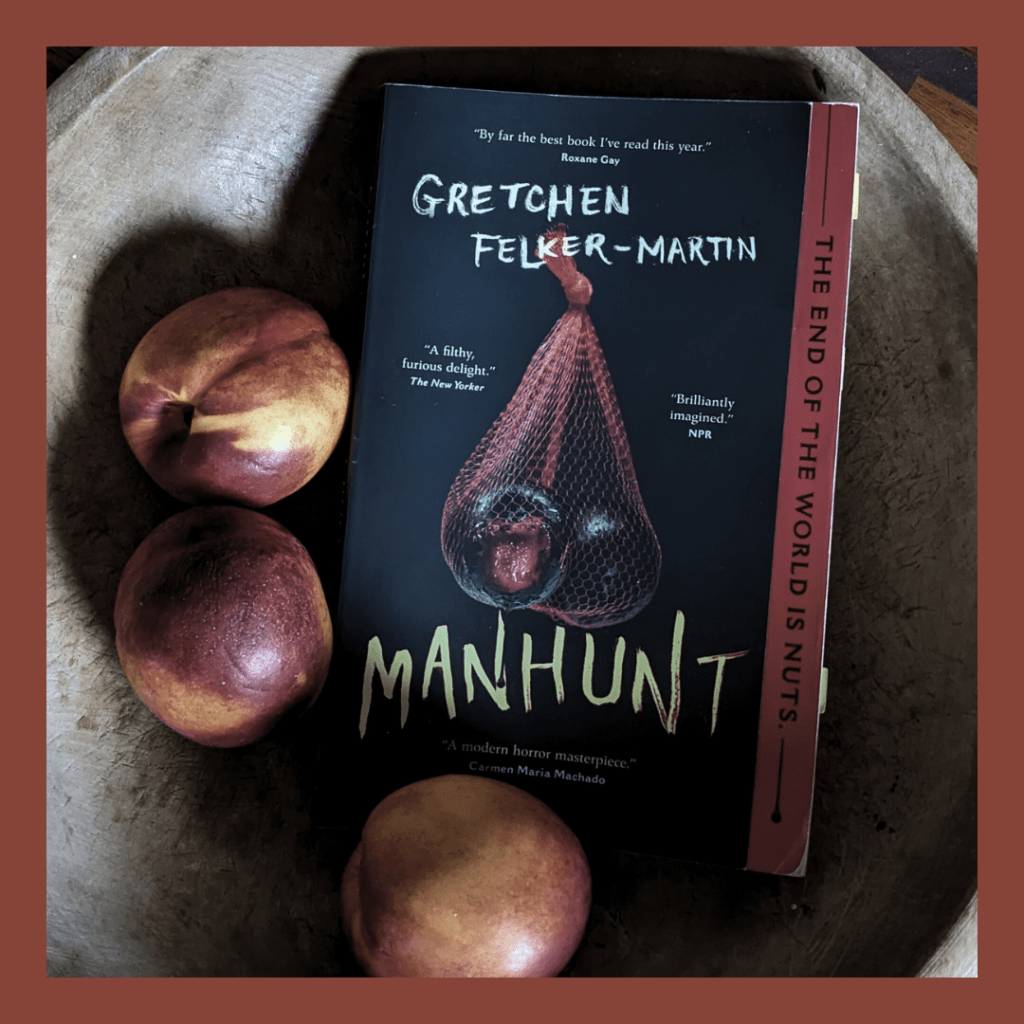
On an apocalyptic Earth, all cis men either are infected, or are on their way to becoming infected, with a virus that turns them into savage, revolting, mindless creatures that are only interested in eating, hunting, and ravaging women. Full of incredibly graphic imagery, I loved how disgusting Manhunt was. I definitely whispered the word ‘gross’ or ‘ew’ several times as I read this in the office during my lunch break, along with the occasional, ‘That’s messed up’. I would almost classify this novel as not safe for work, as there are depictions of consensual sex, rape, drug use, and a great deal of violence, which is really no ones business as no one would know any of that unless they were reading over your shoulder. However, the cover itself had me wondering a few times whether or not I should keep it hidden. I loved how the cover art made use of a slang term to give you a hint of what lies within, but I also found it humorous as I enjoy watching a certain trio of British car enthusiasts and they refer to their male parts as plums. 

This book was really real. By that I mean nothing was sugar coated. The way the author wrote this sounds exactly like I imagine things would probably be if something like this ever actually happened. There was a lot of brutality, even the few moments of peace that the characters had were blanketed in roughness. This novel was a considerable change to the type of material I have been reading lately, and it was riveting. Trans supportive and girl power themes are present throughout.

I really only had two issues with the story as a whole. Towards the end there is a scene where the wrong character’s name was used, the character in question wasn’t even in the same town, and that bothered me a lot, way more than it should. But I caught it immediately, I even went back and read the scene again to make sure I wasn’t crazy. I don’t know how the author or an editor didn’t catch it but Beth’s name was just thrown in there and the only people in that particular scene on the balcony were Fran, Viv, and Ramona, I’m not counting all the other women that were inside the building. This small mistake just ruined the continuity for me.

Spoiler warning, don’t read this next part if you intend to read the book. I wasn’t going to even mention this when I started writing, but I’m puzzled so now I do want to talk about it. At the very, very end there was a scene between Beth and Teach in which Teach calls her Branden, and I didn’t know what to make of it. Did Teach know Beth/Branden from some chance meeting in the past, and in that moment recognize her? Or was Beth/Branden her brother, which I thought maybe the author was trying to hint at seeing as Teach was thinking back on her trans brother shortly before this encounter. Beth says, ‘No’ when Teach calls Branden. Was this because she did not want to be called by her male name, that Teach somehow, miraculously, guessed, or just because she did not want to be called any male name seeing as she identified as a woman? Maybe I just missed the meaning of that entire part. 
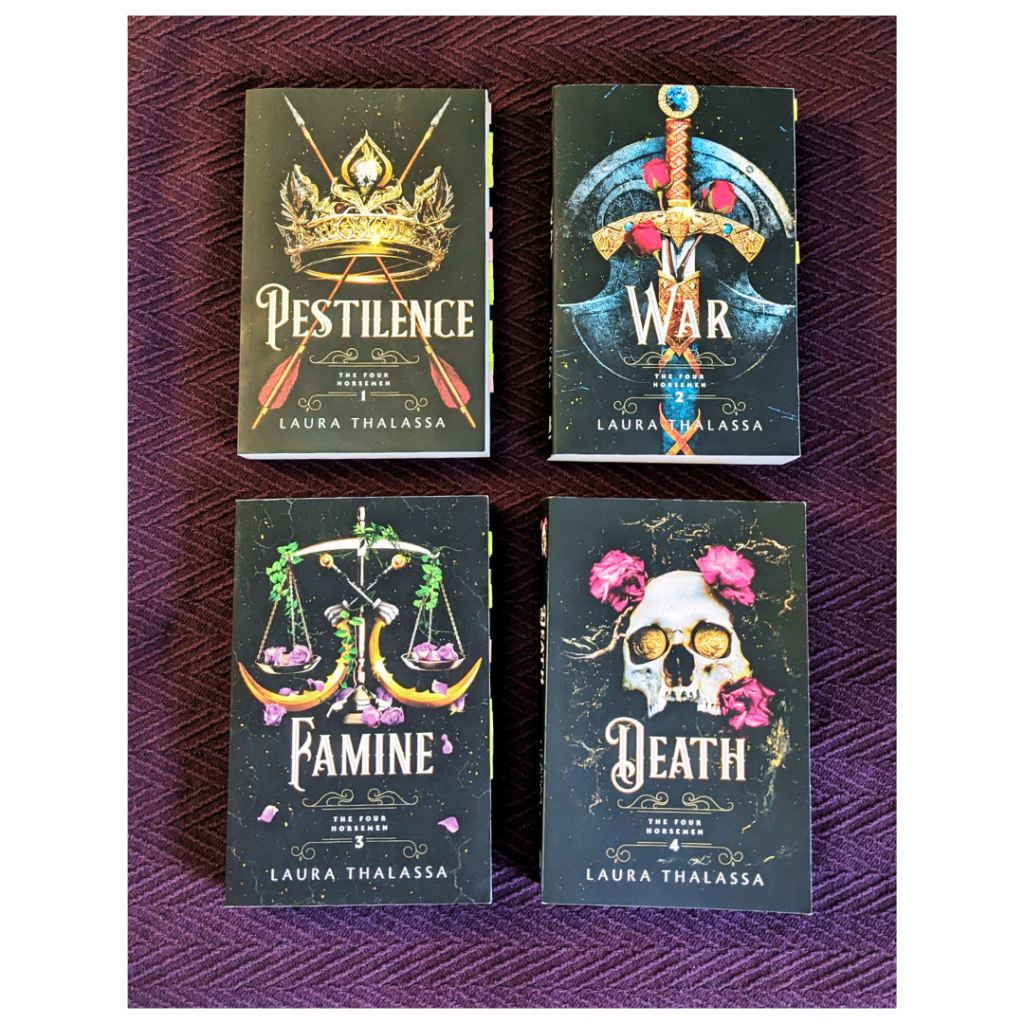
Death by Laura Thalassa

This was my favorite book in the series and I am going to gush about it. In the previous three books Death has been described as the worst of the horsemen, and this led me to believe that I would like this tale the most because I always fall for the villain. And there truly is no one more villainous than Thanatos himself. Add to that that the female main character, Lazarus, is something special herself and I couldn’t help favoring this story over all the others. She is not an ordinary mortal woman like the paramores of Pestilence, War, and Famine. From the moment Death meets Lazarus he knows that she has been made specifically for him, as his temptation, his test. This woman does not die from his powers. On top of that, she also cannot be killed by touching his skin as all other mortals do. And every time Death attempts to kill her, she comes back to life in the same way that the horsemen do, healing slowly, regenerating. 

Death and Lazarus dance around each other for months in their unique love/hate relationship. Lazarus, like the women before her, is determined to do anything to stop Death and save as many people as she can. Death, the most powerful and stubborn of the horsemen, is determined to succeed where his brothers have failed out of both duty and spite. But succeeding in his purpose would mean the loss of the one thing, the one person he has ever wanted, Lazarus and her love. I don’t want to spoil anything, so I’ll leave it up to you to find out whether or not Thanatos ultimately decided if humanity was worth saving. 

One of the big things I really liked about this series was the very vague physical descriptions of the female main characters. With each book I read I wondered if it was intentional. We know that Sara has hazel eyes and brown hair, Miriam has dark brown hair, Ana has curly hair, and we don’t know what Lazarus looks like at all. The physical descriptions diminish with each book and I wonder if it is some kind of metaphor about the four horsemen and the meaning of life. Or it could just be the author’s way of allowing the readers to see themselves as the main character. It is easier to do so when you don’t have a physical description of what they look like. 

This is definitely a series that is worth reading and rereading. I know there are a lot of people out there that are skeptical about getting into a book because it is currently popular, but I am telling you that these four are ones that will not disappoint. They are primarily romance novels, dark romance at that, but there is depth in the religious and philosophical tones and themes of loving your fellow man, change, and sacrifice. I would also like to mention that they are some of the most beautiful books that I own. They currently only come in paperback, but the cover art is stunning and the covers have this velvety feel that makes me really enjoy touching them. The font style and size suit the tale, which is something that can make or break a story for me. I can’t wait to have a proper room with a big bookshelf so that I can proudly display them and look at them all the time. 

Famine by Laura Thalassa

Sixteen years after the Four Horsemen were first spotted on earth, after Pestilence and War gave up their purpose and their immortality for love, their brother Famine makes his first appearance. The story begins eight years after Famine is brought to life, making his reign of human slaughter the longest so far. War was right when he warned Miriam that Famine was amongst the worst of them, and he becomes even more inclined to kill after he experiences some of the worst of humanity.

The way Famine makes his way around the world fulfilling his duty is somewhere in between the methods we saw from War and Pestilence. Sometimes he is a lone rider, sometimes he has a small gang of men with him. He seems to not only truly enjoy killing but in being unpredictable. By the time he encounters Ana, a Brazilian prostitute who he takes captive, he has made his way around almost the entire planet, something his brothers never even got close to accomplishing. He has not only been destroying crops in order to starve humans to death, he has been finding great joy in killing people immediately, by either crushing them with plants, or having his followers stab them and throw them into pits or piles where they are either buried or burned. 

Knowing that there is one more book to follow, I don’t think I need to tell you that Famine changes his ways for Ana. And tying into that, I was correct about the angelic sign. Ana did something that made Famine believe that she was meant to be spared in the moment, but ultimately it was her kind nature that made him decide to stop killing. In doing so, he was convinced to give humanity one chance to change his mind, stating that he would decide whether or not he would continue his purpose at the end of her life. But when he takes a moment to consider what his life might be like when Ana dies, he decides that he does not want to know, he does not want to exist without her. He decides that he too, like his brothers before him, wants to become mortal so that he may grow old with his love and die when she does. This decision triggers the birth of Death and it makes the end of this novel so exciting! We get to see Death in action before his dedicated book. And all I could think of during these last few pages was how will any woman be able to make Death love her? He truly seems not only the worst of the four, but worse than the other three horsemen combined. I am not sure if this story will even involve a love interest for Death, the end made it feel like things might go in a different direction, but I won’t spoil it for you. I really need to see what happens. I am very motivated to start reading Death so you can expect a review of the final book in this series next week along with my overall thoughts.

War by Laura Thalassa

The first book in The Four Horsemen series ended with Pestilence, now going by Victor, telling Sara that he felt his brother War waking up, exactly five years after Pestilence made his appearance. Book two opens up three years after War has come to earth where he is currently conquering near Jerusalem. 

We see a lot of differences when it comes to War and his brother Pestilence. War is more aware of human nature than his brother Pestilence was, as we first see him three years into his campaign whereas Pestilence was just starting out. War, besides having been on earth for a longer period of time when we are introduced to him, has the experience of living alongside humans whereas Pestilence was a lone rider. He seems to understand human ways more because of this compared to the way Pestilence seemed to struggle to understand certain things. Understanding humans does not give War any mercy or remorse, however. War truly enjoys his purpose, murder, slaughter, battle, raiding and pillaging, this all brings him joy, which differs from Pestilence, who stated several times that he did not enjoy doing what he did. This makes War feel all the more evil.

Almost immediately into the story the female lead, Miriam, comes face to face with War. Upon seeing her up close he claims that she is his wife so instead of killing her he takes her into his camp to live with him. War states later on that he spared Miriam’s life because she had a scar on her neck spelling the word ‘surrender’ in the angelic language. Pestilence didn’t kill Sara by either infecting her with his plague or with his bow and arrow because he saw the angelic word for ‘mercy’ spread on her tent in the light coming through the trees. I am predicting that the remaining two horsemen will see a sign in their language that in some way convinces them to spare the life of a woman, and this woman is the one that will convince them to spare humanity, as Sara and Miriam did. Speaking of which, I loved how the reason War decided to stop killing was because he asked Miriam if she thought he could be forgiven. When she said yes, he reasoned that if he, a terrible being whose sole purpose was to kill as much of humanity as possible, could be forgiven, then humans as a whole could as well. 

Overall, I loved this book. I was barely able to restrain myself from starting Famine before writing this. I was tempted because I loved the end of this book, which if you don’t want to know, don’t read past this, just know that I recommend War.

We actually get a very brief glimpse of the birth of Famine! War, like Pestilence, feels his brother coming to life at the very end of the book. We are then taken to the man himself as he is being born. We get a description of his eyes, his armor, and his smirk, he is happy to finally be awake and begin his mission. This is the first time we have seen the actual birth of one of the horsemen, and it really intrigued me to see that he was born excited to fulfill his purpose. I wonder if he will be worse than his previous two brothers. War indicated that the remaining two horsemen were the worst of them and I can’t wait to see in what way this is true.

Pestilence by Laura Thalassa

This book is a far cry from the types of books I have been reading lately, which have consisted of a great deal of science fiction and fantasy novels that are heavy on romance. I was worried that after consuming so many of these books, that in having found my true love in reading in this genre and the very reason why I believe I exist on earth at this point in time, any other type of romance novel would be wasted on me. But I was pleasantly surprised, this was a nice change of pace. It was actually refreshing to read a book that didn’t have odd names that I could never be sure I was pronouncing correctly paired with a backstory that spanned millenia, of which you had to know for the overall story to make sense. 

I was surprised by how much this book not only made me think in a philosophical way about the deep questions of life and what is beyond it, but by how much it made me laugh. The character Pestilence, one of the four horsemen of the apocalypse, doesn’t mean to be humorous but I find him to be so at times. He speaks differently from modern man, elegantly. When he converses in his very serious and purposeful manner, it reads in such a way that it made me laugh literally out loud several times. Being that he is an entity from another plane of existence, he doesn’t always understand modern day phrases. It is very amusing reading about a handsome, muscular, powerful man that doesn’t understand slang terms for bathroom. And I love that the female main character, Sara, teases him by throwing his own archaic words and phrases back at him sometimes. And while there is a good deal of humor in the banter, this is also a pretty dark novel. It is about Pestilence, the bringer of plague, and his victims do not fare well. There are mild depictions of what the plague does to the body which some people might find gross or disturbing. Besides that, there is a a fair amount of torture performed, especially in the beginning, and many assassination attempts. This is a gore heavy book. But if that doesn’t bother you, if you indeed enjoy reading about those sorts of things, I think you will have a great time. 

Being that this book is about one of the four horsemen, you could probably guess that there are additional books for the remaining three horsemen. And you can probably also guess that I will be reading all of them, in order, over the next few weeks. The next one in the series is War, and I am pretty interested to see what this horseman is going to do with his power to attempt to destroy humanity. I think when I finish the series I will give an overall opinion, something I don’t think I have done before. I think this might be useful in letting people know if the series I read are worthy of their time.