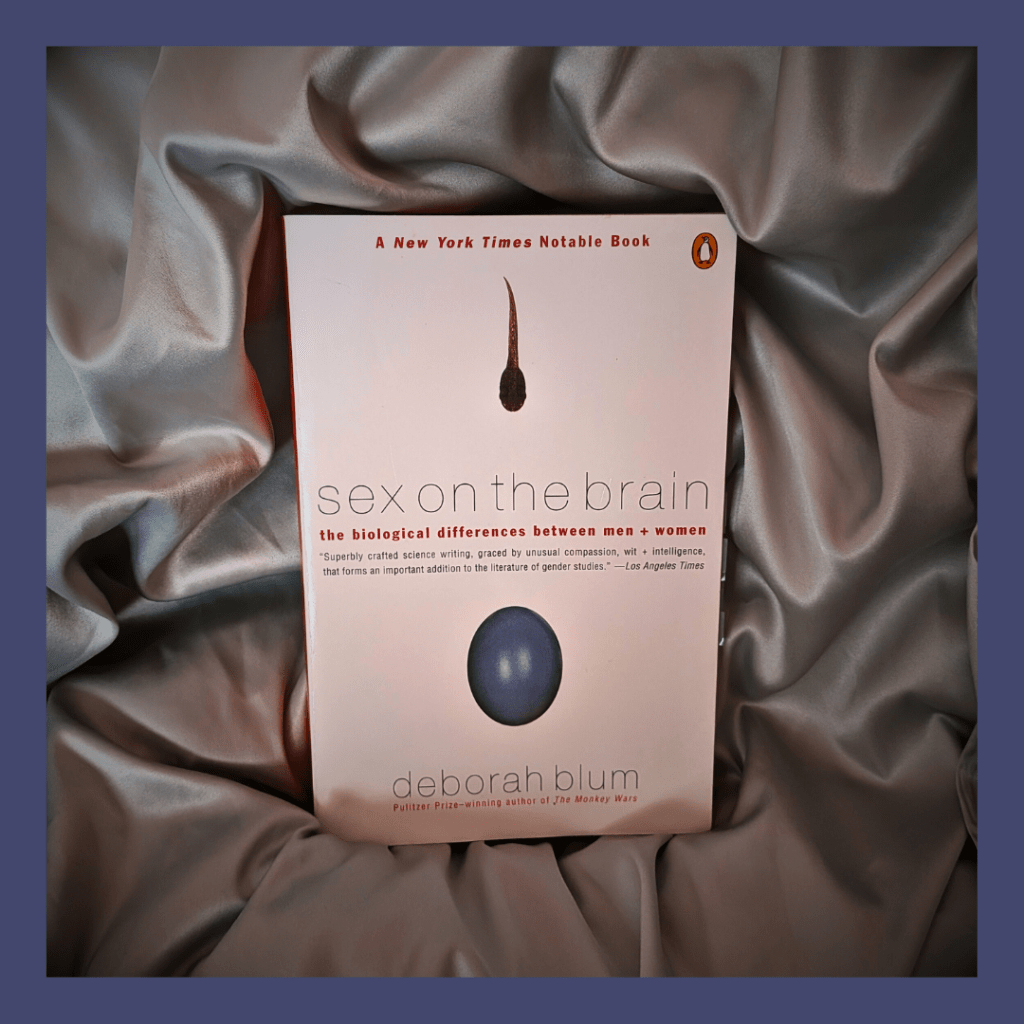
Sex on the Brain by Deborah Blum

Even though this book was first published in 1997, I found that a lot of the information inside was still relevant and held nearly thirty years later when I decided to read it. I have found  that you can tell a book was well researched, and that the theories the author chose to discuss were founded on solid science, when the science is still being studied in the present and the theories are still being pursued. And that was certainly the case here.

This book touches on many different topics that relate to the biological differences between men and women. There are reasons why we are wired the way that we are. Some traits we have carried with us are no longer necessary, think about the useless appendix, and other traits have always been and may always be required for us to function. The author discusses such topics as why is morning sickness still a thing, gossip, the mystery of monogamy, the evolutionary theory as to why it is advantageous for all species to have homosexuality, and the reason why some hetersexual men get both angry and jealous of homosexual male couples. Really, this book has it all. There are two particular topics that I wanted to discuss with some depth as they are topics that I am always drawn to. And I chose these in particular because the author was discussing them back in 1997, and they are still important bits of science that those in the field are still considering today.

The author seemed to have really good intuition into what the future holds genetically in a passage discussing chromosomes. The X chromosome has most of the genetic code on it, around two thousand genes, whereas the Y chromosome has less than eighty.  It is widely known that it is the male’s genetic material which determines the gender of the child, women’s eggs are all X chromosomes and male sperm have either an X or Y chromosome. The Y chromosome mostly just exists as a signal to make the embryo into a male human. Without the Y chromosome, we would all be female. Scientists are currently trying to determine if a female’s bone marrow could be used to fertilize an egg, thus creating a human with the genetic contribution of two women rather than a woman and a man. If this is something that can be done, males will eventually become obsolete. Being a man does put you at a disadvantage genetically, and if in the future more people are more concerned as a society about producing a healthy child, then they might not want the option of having a male. If you are a woman and you inherit a bad gene on one X chromosome, but a healthy version of the same gene on the other X chromosome, you get the good one. The same is not always true for a man, if that gene does not exist on the Y chromosome then you get stuck with the bad gene. There are many disorders that are more prevalent in men for this reason. I found this extremely fascinating. 

Another topic that always captures my interest is body size in relation to male genital size. In species where the males are physically much larger than the females, you will see very small genitals. When the females and males are similar in body size, the genital size becomes more proportionate to that of the body. The topic was touched only briefly, but it was explained in easy to understand terms here. But I always find the theoretical discussions on this topic insightful from an evolutionary standpoint. I enjoy pondering the why behind the designs of animal forms. 

Besides the very entertaining biological content, I was really amused with the names of some of the people in this text. I found it hilariously coincidental that several people had names that suited their careers. John Wingfield, an avian biologist, and Marc Breedlove, a behavioral endocrinologist who studies hormones, just to name two. And as I have said a few times before, a non fiction book, regardless of the topic, is always much more pleasant to read when it is well written. The author had a sense of humor and was relatable. I like it when an author adds tidbits from their life that go hand in hand with what they are writing about.
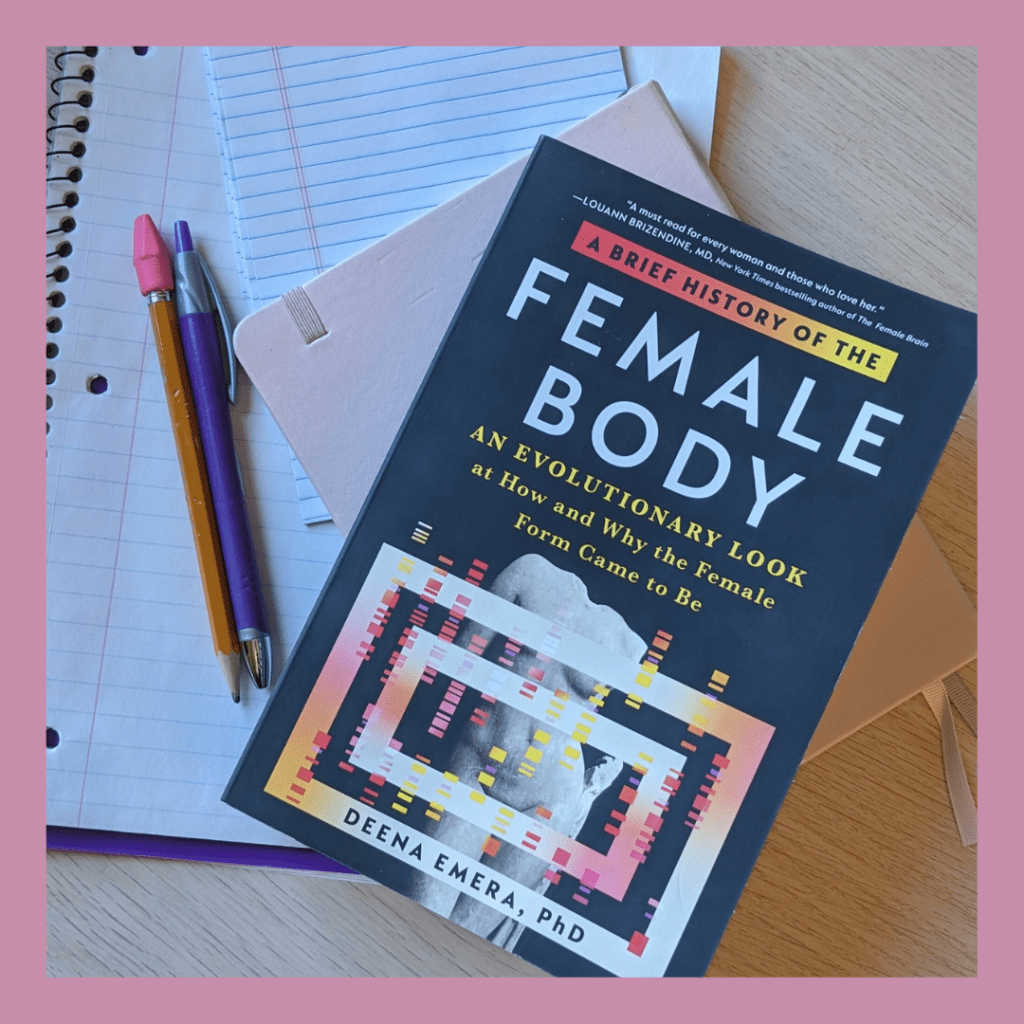
A Brief History Of The Female Body by Deena Emera

I read this book in tandem with the last book I posted about, and if I were a sex education teacher or a professor of human sexuality I would include both of these books on my mandatory reading list. I would put this book at the very top of that imaginary list, as I found it very easy to read and well written, especially for a text that educates so well. I am always appreciative of a text that is educational but also entertaining. Are You Coming? was more of what I would call fun educational, A Brief History Of The Female Body was more evolutionary and theoretical educational. I read so many fascinating things that I was happy to feed my brain.  I feel a little bad for my friends, I was so enthusiastic about certain theories that I started talking at length about them. I think I may have bored them a bit with my nerding out. 

So I guess that is a good way to segue into what I found so amazing about this book. Are you interested in reading about some of the theories that try to determine why human females are the only mammals that have breasts year round, not just during pregnancy and breastfeeding? This is the case with all other mammals, what makes us so different? Or, do you want to learn about why we are one of the few species that menstruates, and so frequently at that? These are just a few of the topics that I found myself mesmerized by. The other topics covered in this book include pregnancy, and everything that goes with it, child rearing, diseases, menopause, and love and bonding. The beginning is a little heavy on chromosomes, genetics, and evolution. It can be reminiscent of high school science class but it was much more enjoyable than classroom learning. There are also some nice illustrations that I found very helpful, as trying to visualize what the author was describing was not easy at times. 

I love that professionals in the field are getting even more involved in studying the female body. From what I have been reading, for a long time scientists thought that they knew all they needed to know. But there are still many, many mysteries when it comes to the female reproductive system and other bodily functions and body parts that are particular to the female. I look forward to hearing more about it from both this author and others. 

Behave: The Biology of Humans at Our Best and Worst by Robert M. Sapolsky – Chapter 17, Epilogue, and final thoughts

Chapter 17 (War and Peace) is kind of like a giant review of everything that was discussed in the previous 16 chapters. Sapolsky goes over how if, historically, you consider how terrible some of our behaviors of have been, we have evolved into relatively decent beings, as a whole. Consider acts we once considered normal, burning witches and lobotomies, that are no longer viewed as acceptable. The fact we don’t burn men and women who are suspected of witchcraft, whatever that means, is an improvement. We don’t remove parts of the brain of the mentally ill without serious medical and moral consideration, whereas in the past it was done without question to make these individuals more manageable as they were sent to institutions. These are just two examples of many, we have improved in so many ways. And there is still room for further improvement. Just believing that something can get better can start a chain of events that can lead to change.

The Epilogue is very short, and mostly consists of bullet points of all the themes found in the book. But on the last two pages, the author wrote something that left more of an impression on me than the bulk of the book, which is 675 pages in total, not including the appendix.  The fact that I had access to this book, read it, and understood it (to a point), puts me in a better position than most. In his words, it makes me “ideally suited” to try to improve something that is not right in the world, and for this reason I should try to. I’m inspired to try to find something small that I think I can change. And I may not become well known for my efforts to try to make a change, but if I can improve my behavior or the behavior of someone else, then I think I will have made the author proud.

I debated about whether I should include this additional part in my book reviews, but I get such a joy out of it that I decided that I had to. Before I get into it, I just need to say that I am not an editor. I have no formal education in editing, writing, journalism, English, publishing, or any related field. I’m just a person who is fond of reading. Now, when I’m reading a book, if I come across a spelling or grammatical error, I get giddy.  A book has been mass produced and I happened to find something incorrect.

I only found one error in this book, a grammatical one, and I almost missed it. The second paragraph on the page begins with the word “the”, but when you read it, it doesn’t sound correct. I believe the sentence should begin with “this”. I’m not going to hold this against anyone (pun intended?). For a book this long, it’s incredible that I only noticed this one very small mistake.  

I will also be concluding my reviews with final thoughts. If you like science, biology, psychology, and have a very good working knowledge of the subjects, this is a great book for you. Myself, I had a lot of trouble getting through the book because none of these are my areas of expertise. But it was written in such a way that I was entertained even though I was struggling. The author has a great sense of humor and he does warn you that things will be difficult to understand if you are not well versed in the subject. He is very considerate in his inclusion of an appendix, and his footnotes are informative and funny when it’s appropriate. In a few years, I might pick this up again and hopefully I will be able to better understand what he has taken such immense care to write about.

Behave: The Biology of Humans at Our Best and Worst by Robert M. Sapolsky – Chapter 15 and Chapter 16

Chapter 15 (Metaphors We Kill By) was a relatively easy chapter for me to both read and understand. I learned that although we encounter metaphors daily, they are relatively new to us as a species evolutionarily speaking. Because of this, we do have trouble some identifying metaphors. I learned that there is an association between cleanliness and organization and feeling good about something, and filth and chaos having an association with being bad. The author made a remark that doing something simple like cleaning your home or doing your laundry can be incredibly relaxing when the rest of your life is a mess, and I very much related to this. I feel very good after completing a chore or cleaning up, and when my home is a mess, I very much feel unhappy and indeed, dirty. I then learned about how even touch can influence how we perceive something. In studies, when subjects were led to interact with something pleasant, an activity they were directed to afterwards was described in a positive manner. When subjects had to interact with something unpleasant, the following activity was later recounted in a not so positive way.

Chapter 16 (Biology, the Criminal Justice System, and (Oh, Why Not?) Free Will) discusses if we have total free will, no free will, something in between the two, the biology behind it, and how neuroscience is being used in the courtroom. There are a lot of topics in this chapter that are debatable, controversial, and philosophical. Does having brain damage impair your ability to make decisions? If so, should this disability excuse you from a crime you committed, or should you be condemned the same as a person with a healthy brain because there are others with your same disability who have never committed a crime? How do we make these types of decisions? We cannot base decisions in criminal cases, or in any type of situation really, on only one factor. We are reminded of all the other chapters read prior to this, our behaviors are a product of our biology, both our pre- and post-natal environments, the society we live in, memories, outside stimuli, whether or not our brain is fully developed, the list goes on and on. This was one of my favorite chapters, and while I’m not sure if I would read this entire book again, I would definitely reread this chapter.

Behave: The Biology of Humans at Our Best and Worst by Robert M. Sapolsky – Chapter 13 and Chapter 14

Chapter 13 (Morality and Doing the Right Thing, Once You’ve Figured Out What That Is) looks at what morality is for humans. Morals vary depending on culture, something that is taboo in one culture is a part of everyday life in another, but there are a few morals that are found world over. I took a lot of notes about cross cultural differences that were discussed, particularly the section about how in collectivist cultures it is common to shame a person who has done wrong according to the morals of the community, and in individualist cultures it is more common for the person to feel guilty over a rotten judgment they have made. This has to do with collectivist cultures putting focus on social roles and being part of a group, your poor judgment reflects badly on the whole group, thus, we will now shame you for it. Whereas in individualist cultures, where the individual and their privacy are valued, their poor judgment may not be known to others, so they must face only themselves with the knowledge of the wrong they have done. And when we make a poor judgment, we sometimes try to rationalize our decision through reasoning. Yes, our seemingly wrong or poor decision was made but it is acceptable and this is why. We try to reason with others, and ourselves, when we make a questionable decision.

Chapter 14 (Feeling Someone’s Pain, Understanding Someone’s Pain, Alleviating Someone’s Pain) discusses empathy, sympathy, compassion, how we deal with our own pain, how we deal with others pain, and when and why and in what situations would we help others that are in pain. If you see someone being pinched, and you think of yourself being pinched and you flinch at the thought, this is sensorimotor contagion. Emotional contagion is when you become a part of what is going on around you, such as deciding to join a group of protestors that pass you as you are walking down the street. Mimicry is simply copying another person’s movements as you see them doing the action. I enjoyed reading about mirror neurons and the theories that try to explain why they do what they do (read to learn more about them). The chapter ends with a discussion about altruism, with a small section detailing pathological altruism which I found very interesting.