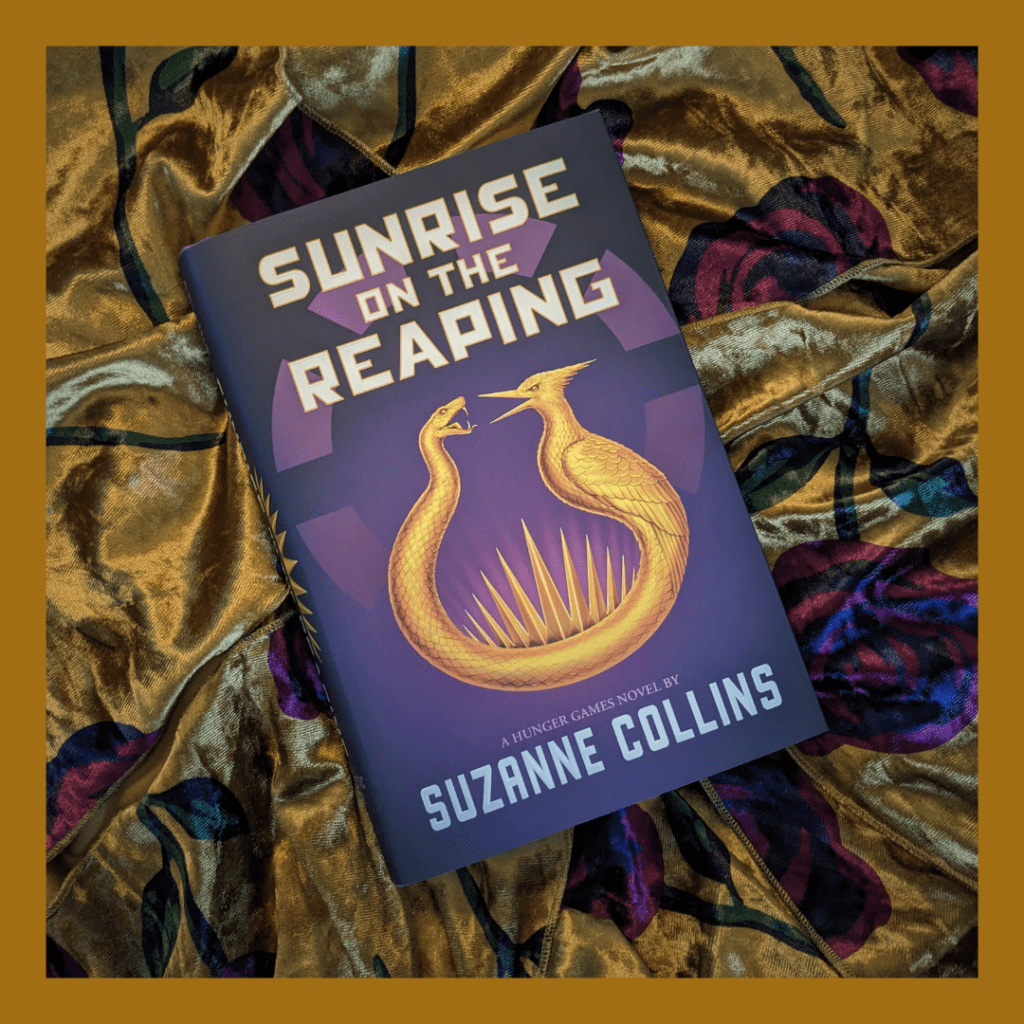
Sunrise on the Reaping by Suzanne Collins

Ever since reading the scene in Catching Fire where Katniss and Peeta watch the 50th Hunger Games, I wanted to know more about what happened in the arena that year. Haymitch not only won, he won while competing against twice as many tributes. I knew that there had to have been something special about Haymitch for him to have beaten those odds. 

Every twenty five years there is a special games, called the Quarter Quell. Before the tributes are selected, the Capital announces an additional condition for the games that year. For the first Quell the condition was that the male and female tributes had to be chosen by the people of the districts rather than pulled from a lottery by a Capital representative, making the punishment even more cruel. The additional bit of barbarism for the second Quell was that there would be twice as many tributes, two males and two females from each district. Haymitch was in the clear once the second male name was called, but due to a series of events that made a bad situation even worse, Haymitch was punished by becoming the second male for district twelve. 

Although there have been some improvements in the way tributes are treated since the 10th Hunger Games, the girls and boys are still viewed as uncivilized animals. They are carted around in handcuffs in windowless vans, and not much is done to ensure that they arrive to the games unblemished and unharmed. The games back then were not the well oiled machine that we see in the original trilogy. I do believe that some of the events that occurred paired with the rebellious actions of Haymitch influenced the way in which the games were run from then on. In the original trilogy there are several mentions of unfortunate incidents that have befallen victors after the games, punishments doled out by President Snow to those that were not shy about showing their disdain for the Capital. We get to experience the very worst of what Snow can do to someone who rebels, and Haymitch suffers greatly for the multiple acts he commits both before the games and during his time in the arena. 

I love that we are getting multiple prequels from the author years after she wrote one of the most recognizable young adult series of this moment in time. This book made me want even more. I didn’t even care that this book was incredibly sad, I loved finding out more about the history of the games and getting to know more about characters that we are already familiar with. There are other victors I would love to have get an entire book dedicated to their story. I think Johanna Masons would be equally as tragic as Haymitchs, but it would be interesting to see how she turned her loss and sorrow into anger rather than depression. I can only hope we are so lucky as to get another prequel out of Suzanne.
The Ballad of Songbirds and Snakes By Suzanne Collins

I don’t know why I didn’t immediately buy and read this book when it came out in 2020, being a huge fan of the Hunger Games series, but I finally got around to it. After seeing the recently dropped trailer for the upcoming movie I knew I wouldn’t be able to wait. That, and I am very much someone who likes to read the book before seeing the movie.

The story takes place as the tenth Hunger Games are about to begin. The war is still fairly fresh in everyone’s minds and the country as a whole is still recovering, including the Capitol. It has been suggested that the games need some livening up in order to get more people interested in watching them, but also, the message of the meaning of the games needs to be made more prominent. Our main character is Coriolanus Snow, the country’s future president, as an eighteen year old student who has been picked along with twenty three of his classmates to be the first ever mentors for the district children. The mentorship is part experiment, for the position of mentors in the games, and part opportunity, in order for the gamemakers to learn how to make the event more engaging for viewers. 

I don’t want to say too much more because it would give too much away. But I will say that as the story progresses you see how Snow started to become the man you already know as the feared and cruel president of Panem. The end leaves me wanting more. One, because the final scene with Snow and his tribute ended too abruptly, in my opinion, even though I recognize that the ending correlates with his tributes ‘song’. And secondly, I want to know more about the things Snow did to acquire the huge amount of power he attains in the future, besides him having an incredibly strong ally who has taken in Snow as her protege. I do hope that the author considers writing another Snow book, or as I read in a bunch of comments recently, a book about young Haymitch and his Hunger Games.

Nod by Adrian Barnes

This book was gruesome and real, an end of days scenario written by a narrator in the midst of an existential crisis. It’s philosophical, gritty, and manic. The world is coming to an end but the main character never has an outburst, he seems unusually calm as the world and the people living in it decay around him. Perhaps because he has never really been part of the world to begin with, having always felt disconnected from people, is what makes it easier for him to accept the reality of what is happening. Throughout the story our leading man is rational and real. The lack of emotion in this main character was a change for me, but it was a good change of pace. 

I’m not sure if this is a book I want to keep, I don’t think it is something that I could read again, but I am not going to say that it isn’t worth a read, because it is. I will say, if you love cats, there is a very graphic description of some cruelty in the middle that I definitely do not want to read ever again, I don’t even want to go back to try to find the pages for anyone who wants to read the book but skip that part. This is one of my most interesting finds during one of my many book store browsing sessions.