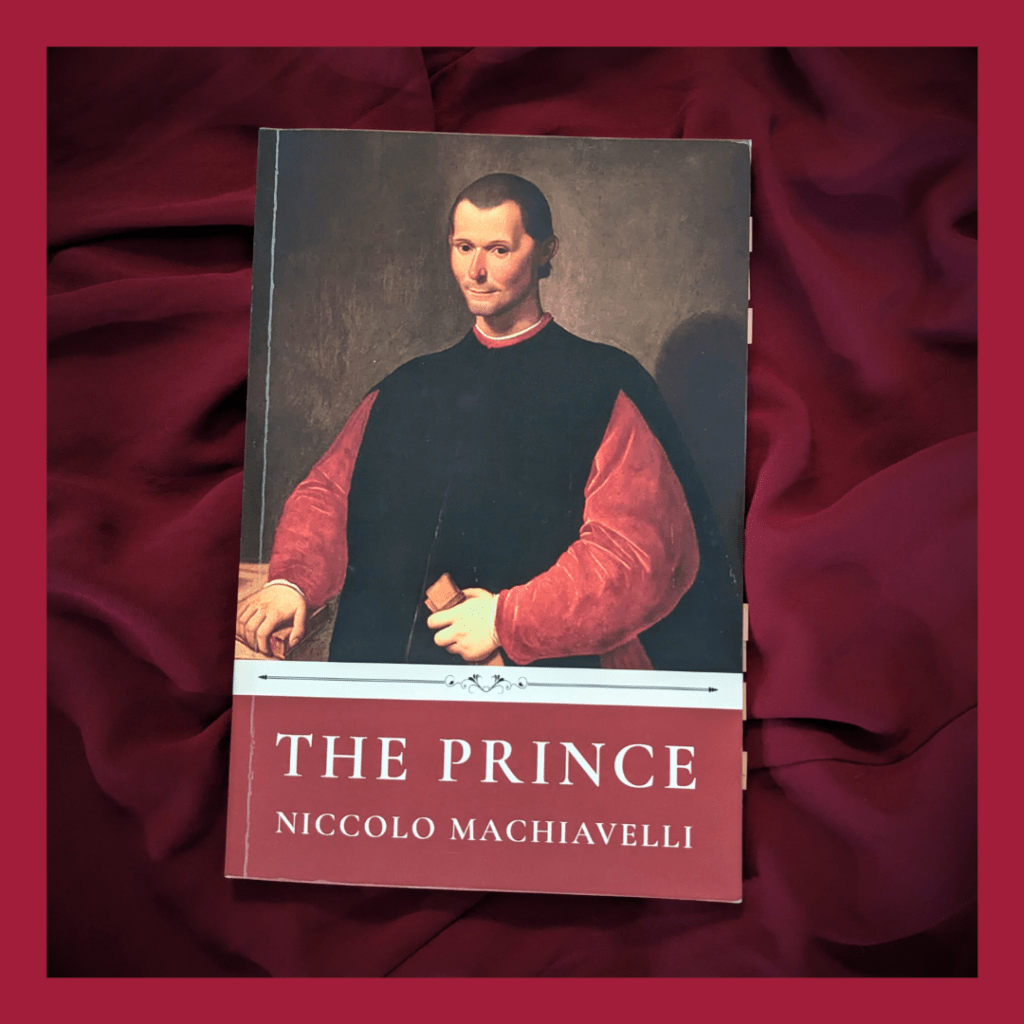
The Prince by Niccolo Machiavelli

A part philosophical, part political text which instructs how to be the best kind of ruler according to the circumstances that lead up to your ascension as well as how to conduct your reign after, this is another book I have acquired for my banned books collection.

I don’t expect to ever be a ruler of any kind, but I can see how this could be helpful if I were to somehow fall into a position of power. Not every person at the head of a country or government deserves to be there, and certainly not all of those people are cut out for it. Whether you have inherited your power, taken it by force, or been nominated by others, Machiavelli outlines how to rule well so that ultimately you can remain in that position. I do believe that there are many people in power today who could take a lesson, or several, from this text.

I can see why this is on banned book lists. Even though it was written in the 1500s, it is still relevant today and the man makes many good points. He makes examples of many things that I think are obvious but apparently they are not so obvious to others. It is a book that gives people something to think about. It will make you question why we allow some glaringly terrible leaders to remain in power. It also gives examples of the things that can happen to bad leaders, which should hopefully have been enough to make those leaders who read this text want to do a good job. And while overly violent assassinations are not so common today, torture, beheading, and dismemberment, just to give a few examples, I would think that wanting to remain in the good eye of the public would be enough to make leaders want to try to do what is best for the people.

I think this is a good book to keep around, but I don’t see myself reading it in its entirety again. The chapters are short enough that you can go back and read only the passages that interest you or that you want to pull an example from. I did mark a few pages, mostly excerpts that I found had relevance to the current political climate in this country. There was one very small paragraph towards the end that irritated me, regarding beating women, but I tried to remind myself that this was written during a time when women’s rights were pretty much non-existent and to not get too worked up over it. I didn’t let that one passage change my entire opinion of the text, and notwithstanding that I would recommend reading The Prince as well as have you consider adding it to your physical book collection.
The Mastery of Self by Don Miguel Ruiz Jr.

This book I borrowed from my friend after I saw it in his room. I wanted to read it as soon as I saw it because it was laying in the room of a man who does not read, so it must have been something very special for him to have brought it home. 

This is a quick read, but you get so much out of it in the short amount of time it takes to get through it. It’s both religious and spiritual, insightful and helpful, particularly for those who take the time to consider the hypothetical scenarios and perform the exercises at the end of each chapter. It’s also philosophical, you question the methods as you are reading about them, you wonder if the practices as described by the author would actually help you. I found myself interested in trying some of the exercises but also doubting the usefulness of others for me personally. Perhaps I doubted some of the practices because I am in a very negative mood right now, there is not a lot in my life that is going well at the moment. There were a lot of ideas that I did not see as being useful for me in the present or in the future. Perhaps I should come back to this book when I am in a more positive place and reassess the contents within, although I feel like that is opposite of the point the book is trying to make. It gives the impression that you need to love yourself at your worst or you will be unable to love yourself at your best although the message is much deeper than that. I think, in the end, I can probably take a few of the ideas here and find a way to use them to help myself.

This Is Your Mind On Plants by Michael Pollan

This Is Your Mind On Plants is definitely going on my list of best books I have read this year. It was educational, extremely interesting, and insightful. It is exactly the type of non fiction book that I like to read, a book that is written in such a manner that it is entertaining so much so that you forget that you are learning. I loved the mixture of historical stories and facts blended together with the real life experiences of the author as he researched and ingested three different plants in order to provide the best possible insight. He wanted to give the reader an understanding of what is a downer, an upper, and an outer, and he did an amazing job. 

The first part of the book is about downers, in this case, opium. This may be naive of me, but considering the fact that I do not use recreational drugs and I only rarely get prescribed a painkiller for medical reasons, I did not know that OxyContin, a famous opioid, was a downer. I also did not know that overdose and addiction to this prescription drug led to the deaths of hundreds of thousands of individuals. Deaths did not only occur from the very drug itself, but from those who turned to illegal forms of the drug after they could no longer get them legally. A disturbingly large number of new heroin users have turned to illegal drugs after becoming addicted to prescription painkillers. This is frightening, and I’ve gotten a little off track, but I was really moved by the above facts. The form of opium that the author explores for research purposes in this book is poppy, a plant that anyone can grow in their backyard gardens. The back and forth between what is currently legal and illegal, right and wrong, when it comes to growing poppies, was absolutely enthralling. I especially loved getting to read the original piece on the author’s experience growing poppy and drinking the tea which he wrote decades ago. At the time he was unable to publish for legal reasons, and the piece itself was lost for years before it was found and finally deemed safe to publish. 

Part two was about uppers. The easiest upper to get in the world, considering that it is legal everywhere, is caffeine in the form of coffee or tea. I learned a lot about a substance that I consume almost everyday, yet knew very little about until reading this chapter. There is an interesting bit about why we associate coffee with sobering us up after ingesting too much alcohol, why coffee is associated with masculinity and tea with femininity, and the relationship between coffee and opium and the terrible impact it had on Chinese culture. Although the chapter on opium was amazing, I became completely engrossed with this chapter probably because caffeine is a substance I use regularly. It both made me want to try and take a break from caffeine, if you read you will see why, and also continue to use it so that I can be at maximum potential and productivity.

The final part was about the substance I knew the least about, mescaline, or the outer, and the plants that produce this substance. Illegal to everyone in the United States, with the exception of those who are active members of the Native American Church, the plants have become endangered due to people poaching. This is a huge concern for followers of the church, as the plants are used for religious ceremonies and healing purposes, not to get high. They don’t consider these plants as drugs, and they find the term offensive. The plants are thought of as holy and sacred, and the individuals who are poaching the plants do not have the respect and reverence for them that members of the Native American Church do. You really need to read this chapter to even begin to get an understanding of what these plants mean to these people as a whole. Honestly, from the way the author described it, unless you have grown up within this religion or you join it and devote your whole heart to it, you will never really understand.

If anyone made it through that incredibly long review, thank you. I will try to keep my next one shorter, I don’t think it will be a challenge actually because I don’t think the next book I read will come close to this. I can only hope that I read one or two more books that are this good by the end of the year.

The Art Of Deception: An Introduction To Critical Thinking by Nicholas Capaldi and Miles Smit

This book does not live up to what I imagined it might be. I thought it would be eye opening and insightful, and instead I just found it very dry. It was like I was reading a high school science textbook and an English textbook at the same time, the information was presented to you in that kind of nap-inducing manner. But I couldn’t help but be surprised, especially after reading about the importance of adhering to the English rules of grammar in the introduction, when I found a grammatical error less than fifty pages in. For me, that was the most exciting thing in the entire text.

In the introduction, six parts, and appendix, part three was the only section that I found mildly interesting, or less dry at least, but it definitely peaked there and then fell off. I will say, there is a lot of well thought out information in this book. It is definitely a must read if you are either a law student or considering studying law, I imagine it would be very helpful for learning techniques to implement in the courtroom. Each chapter ends with summary and exercises, and although I did read the summary I did not practice any of the exercises. I didn’t think pursuing the exercises would be worth my time, much like I now feel about having read this book. It’s well written and very educational, it’s just not the kind of knowledge I was interested in gaining.