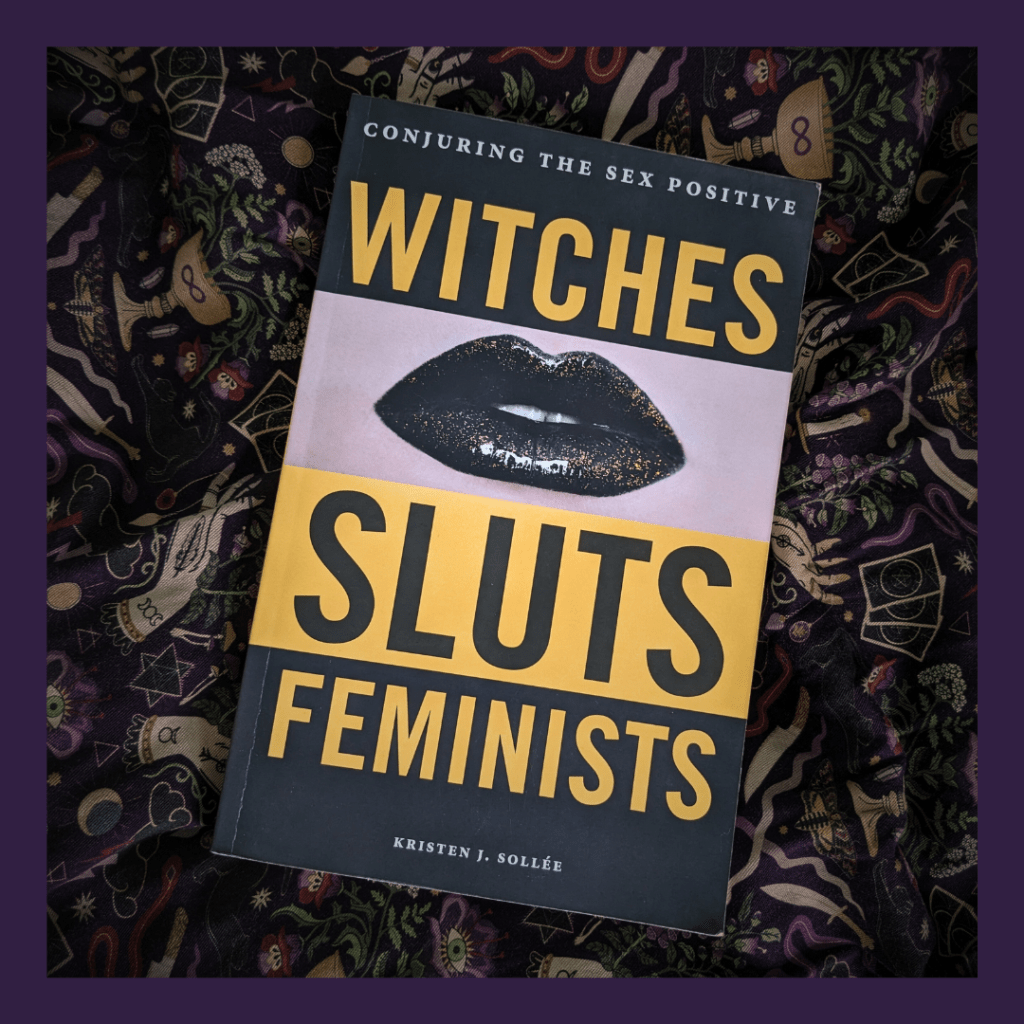
Witches, Sluts, Feminists by Kristen J. Sollee

What is a witch? Do you immediately think of a woman in a black dress and pointed hat holding a broom, perhaps making a potion? Or is your definition of a witch a follower of the Wiccan religion? From Voodoo wielders of the south, to spell casters burning herbs and using the healing powers of crystals, there are many different types of witches, both from the past and in the present. What we think of as a witch has been shaped over centuries, has been influenced by story telling, movies, music, and so much more. What do sluts and feminists have to do with witches? The three words are strongly intertwined, and in some cases can be used intermittently. 

Centuries ago, the word witch was a label given to a woman that was a threat either because she possessed valuable knowledge that threatened a male dominated society, or because she was different. In the instance of knowledge, the woman in question had skills that took away the business of men that were pursuing work in the same field. For example, men were particularly threatened by midwives, even though these women understood their fellow female patients’ bodies better than their male counterparts, and often delivered less harmful and more beneficial treatment. If a female healer became too popular, you can bet that the male doctor running his business in the same area would accuse her of witchcraft if he felt threatened. It didn’t matter if the female healer was better at her job, no man wanted a woman earning more business than him. Any man could claim that any woman was a witch if he didn’t want her taking all his business, and this was not limited to medical practice. 

On the other end of it, witch was not always an accusation thrown at women providing healing services, but also towards women who didn’t fit in with society. If you replace the word witch with slut, you will see parallels with how the words were used in a negative way against women centuries ago versus today. In a town full of plain looking, God worshipping women, an out of town beauty passing through could find herself accused of witchcraft if jealous or frightened wives noticed that their husbands eyes were straying. It is very common today for attractive women to be called sluts, because people seem to think beauty goes hand in hand with promiscuity. In both cases, the woman in question could be completely innocent of the harsh allegations being made, but if enough people grow angry or fearful, the woman’s reputation will be destroyed.

Slut is also a slur often thrown at outspoken women, particularly avid feminists. A smart woman, one who proudly voices her opinion confidently, one who advocates for equality and change, is often referred to as a whore or slut. Feminists are the greatest threat to the patriarchy, and this causes fear. And we come full circle back to witch, a word that resulted in the useless deaths of many intelligent, outgoing, and caring women over centuries. 

This book not only goes into the history of the words, how they are intertwined, but how women today are using these once negative words to bring power back to themselves. They are taking these words that once caused a lot of harm and changing their definitions. Modern witches, sluts, and feminists are making the words positive rather than negative. They are making it harder for women to be insulted by these words, they are making women feel inspired by them. After reading this book, I see how in the right circumstances being called a witch, slut, or feminist could be a glowing compliment. This book makes me want to search within myself, perhaps to find my inner witch, slut, or feminist.
A Brief History Of The Female Body by Deena Emera

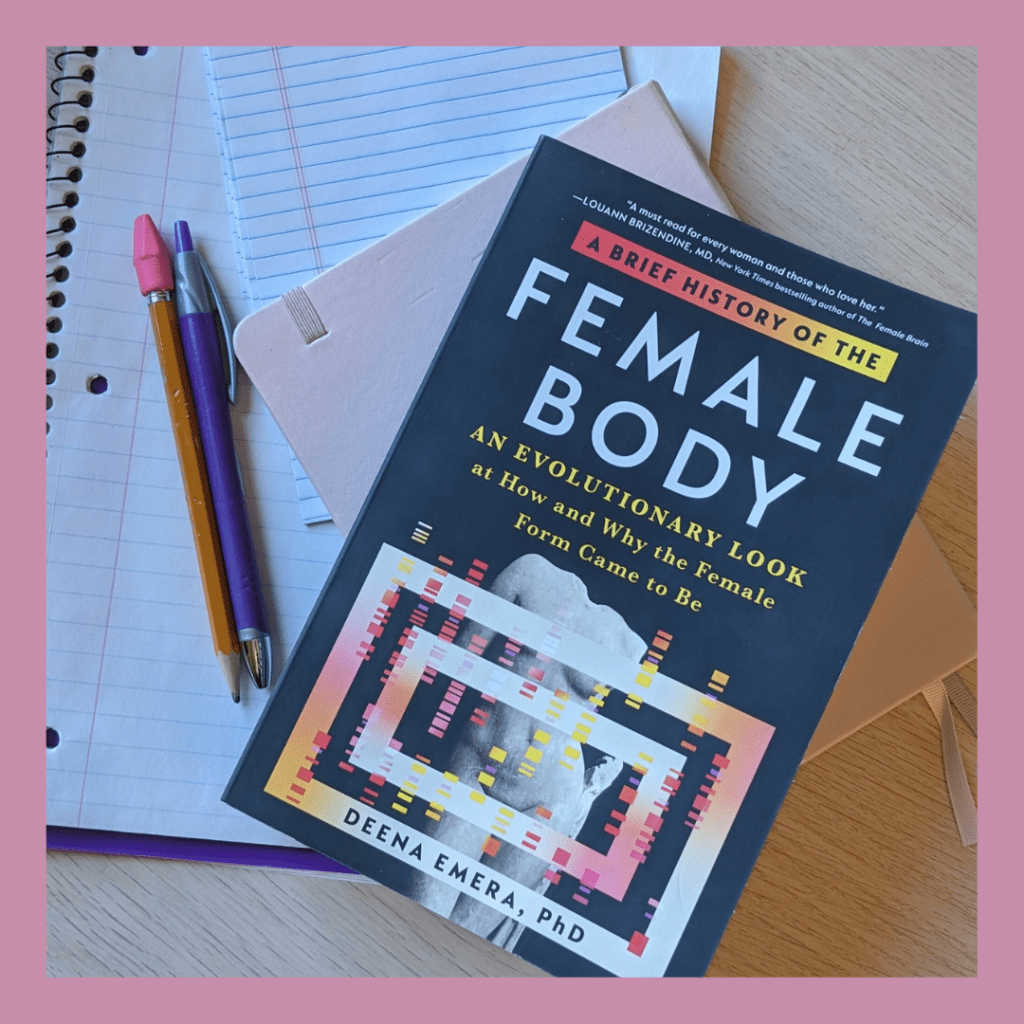
I read this book in tandem with the last book I posted about, and if I were a sex education teacher or a professor of human sexuality I would include both of these books on my mandatory reading list. I would put this book at the very top of that imaginary list, as I found it very easy to read and well written, especially for a text that educates so well. I am always appreciative of a text that is educational but also entertaining. Are You Coming? was more of what I would call fun educational, A Brief History Of The Female Body was more evolutionary and theoretical educational. I read so many fascinating things that I was happy to feed my brain.  I feel a little bad for my friends, I was so enthusiastic about certain theories that I started talking at length about them. I think I may have bored them a bit with my nerding out. 

So I guess that is a good way to segue into what I found so amazing about this book. Are you interested in reading about some of the theories that try to determine why human females are the only mammals that have breasts year round, not just during pregnancy and breastfeeding? This is the case with all other mammals, what makes us so different? Or, do you want to learn about why we are one of the few species that menstruates, and so frequently at that? These are just a few of the topics that I found myself mesmerized by. The other topics covered in this book include pregnancy, and everything that goes with it, child rearing, diseases, menopause, and love and bonding. The beginning is a little heavy on chromosomes, genetics, and evolution. It can be reminiscent of high school science class but it was much more enjoyable than classroom learning. There are also some nice illustrations that I found very helpful, as trying to visualize what the author was describing was not easy at times. 

I love that professionals in the field are getting even more involved in studying the female body. From what I have been reading, for a long time scientists thought that they knew all they needed to know. But there are still many, many mysteries when it comes to the female reproductive system and other bodily functions and body parts that are particular to the female. I look forward to hearing more about it from both this author and others. 

Are You Coming? by Laura Hiddinga

If you have the anatomy of a female, this book is a must read. Most Americans have some form of sex education in school, and I’d like to think my elementary, middle, and high school lessons on the subject were very good, especially when compared to the curriculum of the nation at large. But I learned things from this book that I did not learn in school. To be fair, I will say that a great deal of the information includes discoveries that were probably made well after I graduated high school. Even so, it’s amazing to me that there are so many more different forms of female pleasure than I was previously aware of. On top of that, science is still waiting to discover even more about the female body. 

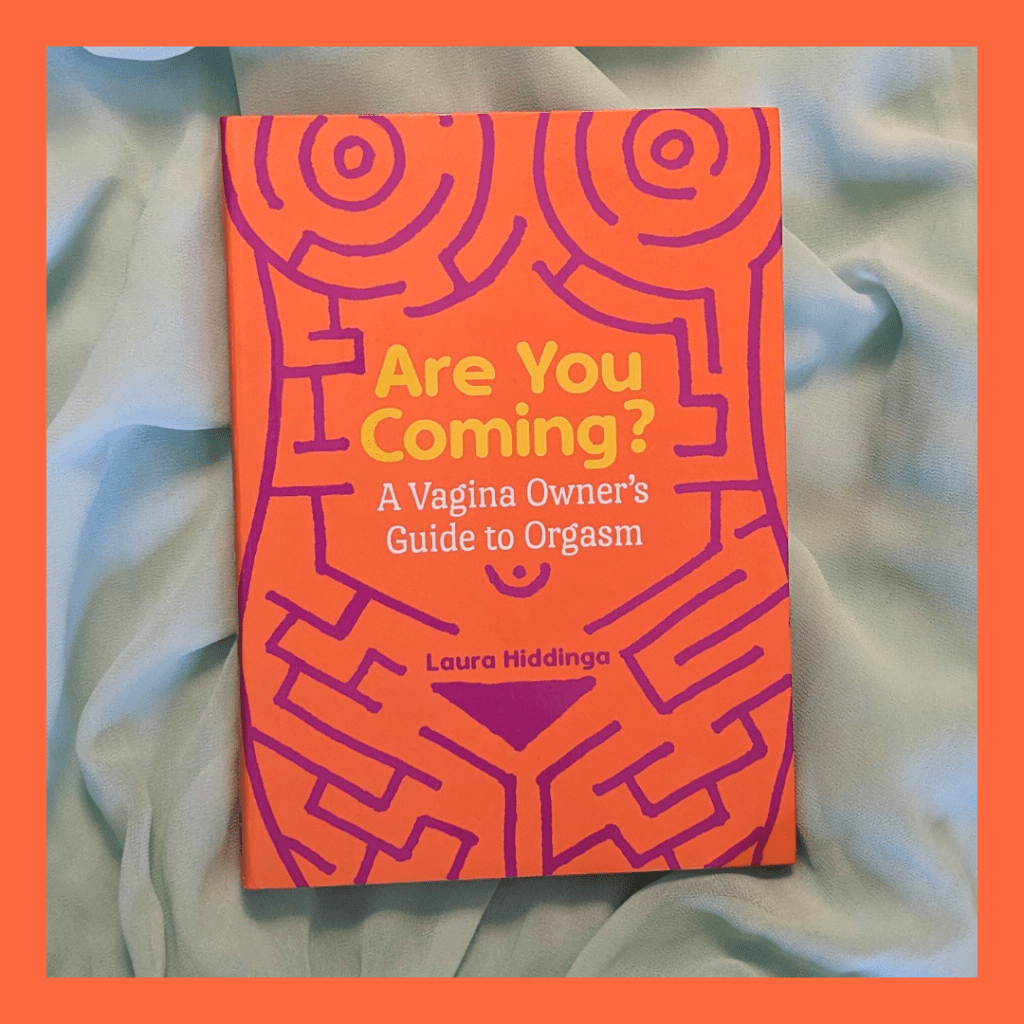
If you don’t want to read an entire book on the subject, even just reading one of the chapters could be very enlightening. In these pages you might find the answers to some problems you might be having, or you might learn that something that you personally experience has a name and is experienced by others as well, making you feel less alone or even amongst friends in a way. The book is broken down into the basics, the different types, techniques, how to talk about it, difficulties with it, positions, and devices you can add. For the length of this book, your money is worth what you pay for it. I also love the cover art. The female body being portrayed as a maze that you need the patience and time to navigate is what I believe the author was going for here, in terms of an artistic metaphor. I explore the female body even further with the book I will be discussing next week. I was actually reading the two in tandem and just finished this one first, but they compliment each other very well. I hope you’ll return to see what I have to say about it.

Manhunt by Gretchen Felker-Martin

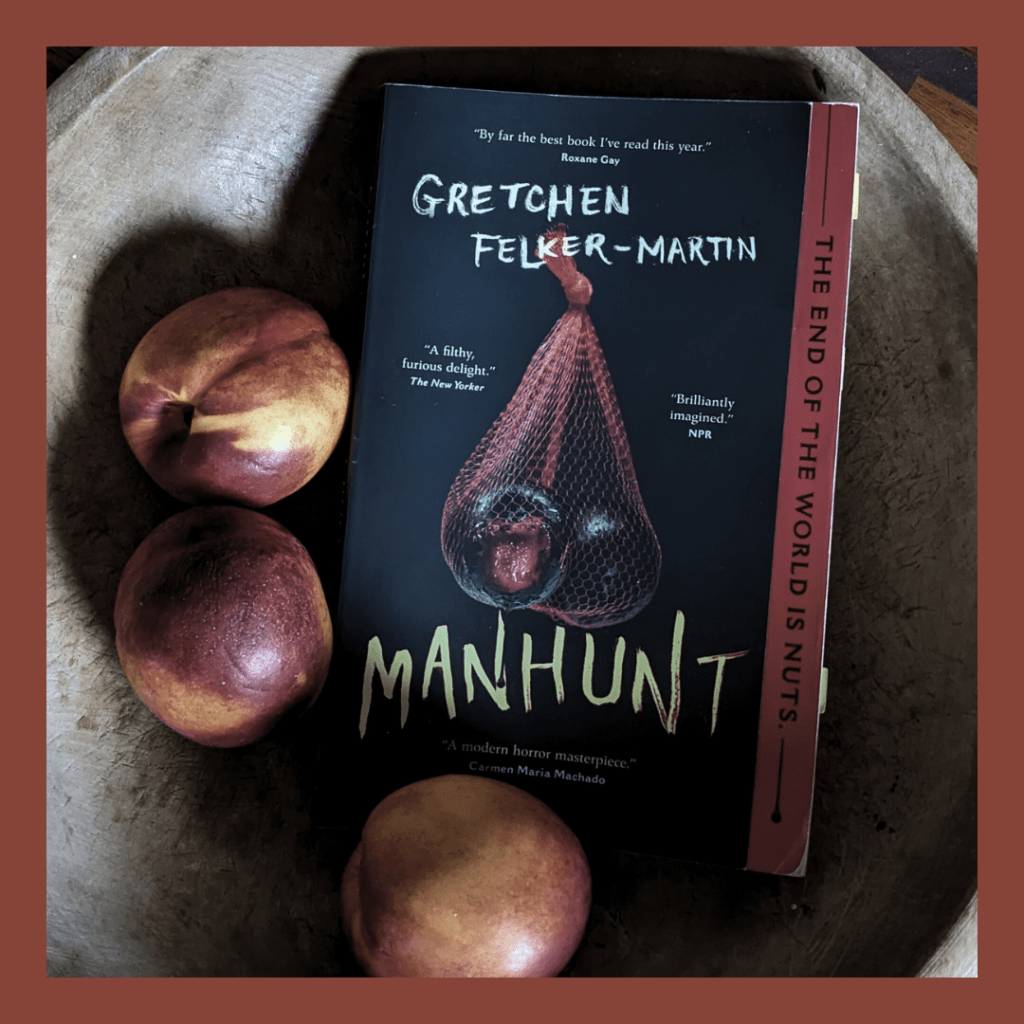
On an apocalyptic Earth, all cis men either are infected, or are on their way to becoming infected, with a virus that turns them into savage, revolting, mindless creatures that are only interested in eating, hunting, and ravaging women. Full of incredibly graphic imagery, I loved how disgusting Manhunt was. I definitely whispered the word ‘gross’ or ‘ew’ several times as I read this in the office during my lunch break, along with the occasional, ‘That’s messed up’. I would almost classify this novel as not safe for work, as there are depictions of consensual sex, rape, drug use, and a great deal of violence, which is really no ones business as no one would know any of that unless they were reading over your shoulder. However, the cover itself had me wondering a few times whether or not I should keep it hidden. I loved how the cover art made use of a slang term to give you a hint of what lies within, but I also found it humorous as I enjoy watching a certain trio of British car enthusiasts and they refer to their male parts as plums. 

This book was really real. By that I mean nothing was sugar coated. The way the author wrote this sounds exactly like I imagine things would probably be if something like this ever actually happened. There was a lot of brutality, even the few moments of peace that the characters had were blanketed in roughness. This novel was a considerable change to the type of material I have been reading lately, and it was riveting. Trans supportive and girl power themes are present throughout.

I really only had two issues with the story as a whole. Towards the end there is a scene where the wrong character’s name was used, the character in question wasn’t even in the same town, and that bothered me a lot, way more than it should. But I caught it immediately, I even went back and read the scene again to make sure I wasn’t crazy. I don’t know how the author or an editor didn’t catch it but Beth’s name was just thrown in there and the only people in that particular scene on the balcony were Fran, Viv, and Ramona, I’m not counting all the other women that were inside the building. This small mistake just ruined the continuity for me.

Spoiler warning, don’t read this next part if you intend to read the book. I wasn’t going to even mention this when I started writing, but I’m puzzled so now I do want to talk about it. At the very, very end there was a scene between Beth and Teach in which Teach calls her Branden, and I didn’t know what to make of it. Did Teach know Beth/Branden from some chance meeting in the past, and in that moment recognize her? Or was Beth/Branden her brother, which I thought maybe the author was trying to hint at seeing as Teach was thinking back on her trans brother shortly before this encounter. Beth says, ‘No’ when Teach calls Branden. Was this because she did not want to be called by her male name, that Teach somehow, miraculously, guessed, or just because she did not want to be called any male name seeing as she identified as a woman? Maybe I just missed the meaning of that entire part.